Amazon Music
 Apple Podcasts
 iHeartRadio
 Spotify
 YouTube
 RSS Feed
 Podcast Addict
 Podchaser
 Deezer
 Goodpods
 PlayerFM
 Castro
 Castbox
 The Partner You Need When You've Run Out of Gas — George Boudreaux & Nathan Rath
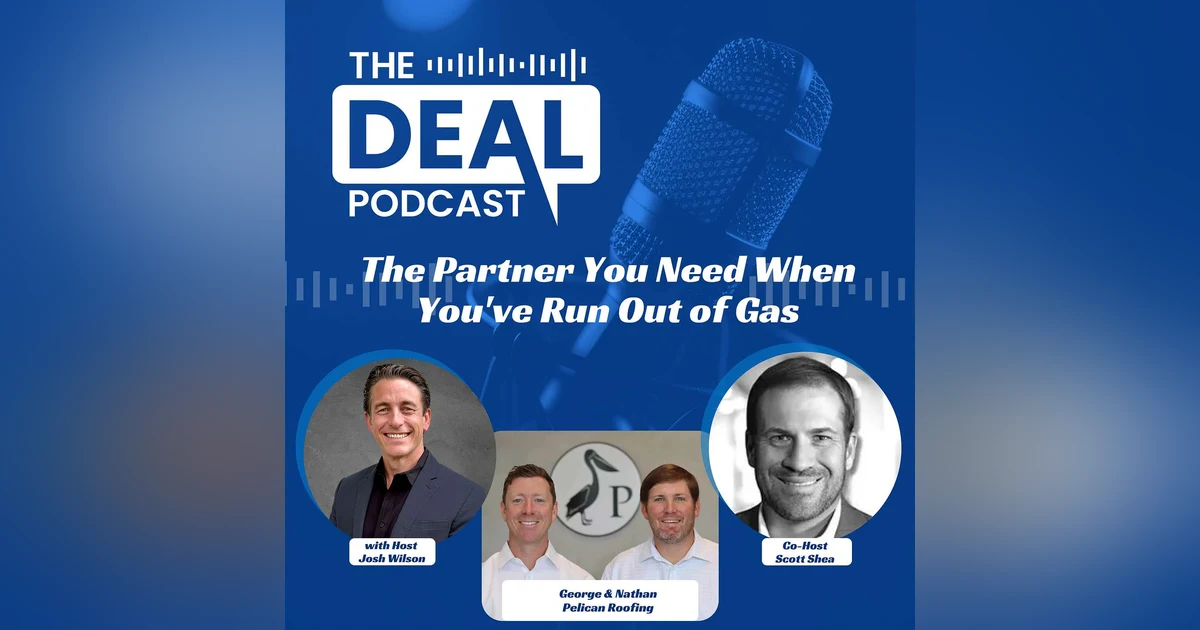

George Boudreaux and Nathan Rath on finding a business partner to grow Pelican Roofing from $9M to $19M — partnership structure, hard decisions, and why they avoided PE.
Key Takeaways
- George Boudreaux founded Pelican Roofing on July 4th, 2014, after losing about $500K in a Houston real estate venture.
- After years of hurricanes and burnout, he needed a partner, not a buyer.
- Nathan Rath left 12 years at Halliburton to join the business.
- Pelican Roofing grew from roughly $9M to $19M in revenue with no storm tailwind.
He was drowning in investor debt, swinging a hammer in Houston just to make payroll — and still found a way to build something worth fighting for. This is a story about grit, partnership, and what it really takes to grow a trade business from the inside out.
George Boudreaux founded Pelican Roofing Company in Lafayette, Louisiana on July 4th, 2014 — not from a place of momentum, but from a burning need to survive. After a real estate venture in Houston went sideways and left him half a million dollars in the hole, he bootstrapped a roofing company and grew it into a regional force. But after years of hurricanes, burnout, and carrying too many people for too long, he knew he needed a partner — not a buyer. Nathan Rath, a 12-year Halliburton veteran who traded oil rigs for rooftops, answered that call. Joining host Joshua Wilson and co-host Scott Shea, George and Nathan unpack the real mechanics of finding the right partner, making hard decisions, and building a business with staying power. Pelican Roofing has grown from roughly $9M to $19M in revenue — with no storm tailwind.
🎯 What We Cover:
- How George lost $500K in Houston and rebuilt from scratch with a roofing company
- Why he started Pelican Roofing on July 4th, 2014 — and what that date meant
- What Nathan gave up at Halliburton and why family drove him toward ownership
- The list George wrote in December 2022: "Find a partner by July 4th, 2023"
- How they structured and inked their partnership deal on August 8th, 2023
- Growing from $9M to $19M with no hurricane boost — and the hard lessons in between
- The first principles exercise that led to layoffs right before Christmas
- What makes a great door-to-door roofing salesperson — and why motivation beats resume
- How Nathan's community roots (and a pelican suit) built Pelican's brand in Acadiana
- What George and Nathan are really looking for before they'd ever do a PE deal
Topics: finding a business partner to grow, scaling a trade business, partnership over private equity, roofing company growth playbook, owner-operator burnout, first principles operating decisions, selling your business podcast
🤝 Connect with George Boudreaux: 🌐 https://pelicanroof.com/ 💼 https://www.linkedin.com/in/george-boudreaux-64031120/ 📘 https://www.facebook.com/BoudreauxGeorge/
🤝 Connect with Nathan Rath: 🌐 https://pelicanroof.com/ 💼 https://www.linkedin.com/in/nathan-rath-2aa371120/
🤝 Connect with Co-Host Scott Shea: 💼 https://www.linkedin.com/in/escottshea/
💼 Thinking About a Transaction? FA Mergers helps founders, investors, and business owners navigate the full M&A process — from valuation to close. If you're exploring a sale, acquisition, or capital raise, let's talk. 🔗 https://www.famergers.com/
🎙️ Follow The Deal Podcast: 🌐 https://www.thedealpodcast.com/ 💼 https://www.linkedin.com/in/joshuabrucewilson/ ▶️ https://www.youtube.com/@dealpodcast
DISCLAIMER The Deal Podcast is for informational and educational purposes only. Nothing discussed constitutes investment advice, a solicitation, or a recommendation to buy or sell any security. Always consult a licensed professional before making financial or investment decisions.
Disclaimer: Joshua Wilson is a licensed Florida real estate broker and holds FINRA Series 79 and Series 63 licensure. The Deal Podcast is presented by FA Mergers and is produced for informational and educational purposes only. Nothing discussed constitutes investment advice, legal or tax advice, a solicitation, or a recommendation to buy or sell any security or to pursue or avoid any transaction. All views and opinions expressed by the hosts, co-hosts, and guests are their own and do not necessarily reflect the positions of FA Mergers, One Iron Network LLC, any regulatory agency, or any employer. Listeners should consult their own legal, financial, and tax professionals before making any business, financial, or transaction decision. This podcast does not constitute a solicitation or recommendation for any financial products or services.
Frequently Asked Questions
When should a business owner bring in a partner instead of selling?
George Boudreaux needed a partner, not a buyer. After years of hurricanes and burnout, he brought in Nathan Rath, a 12-year Halliburton veteran, and together they grew Pelican Roofing from roughly $9M to $19M in revenue without a storm tailwind.
How did Pelican Roofing start?
Boudreaux lost about $500K on a real estate venture in Houston, then bootstrapped Pelican Roofing in Lafayette on July 4th, 2014, out of a need to survive.
Who are George Boudreaux and Nathan Rath?
George Boudreaux founded Pelican Roofing Company in Lafayette, Louisiana. Nathan Rath is his partner, who left a 12-year career at Halliburton to join the business.
00:00 - Welcome & Introducing the Guests
04:00 - George's Origin Story: Real Estate, Risk & Houston
07:00 - Losing $500K and Picking Up a Hammer
09:30 - The Identity Crisis Behind the Financial Crisis
13:45 - Nathan's Path: Halliburton, Family & the Search for Something His Own
18:00 - How George Found Nathan — And the List That Made It Happen
23:00 - The First Year of Partnership: What Nathan Didn't Expect
25:30 - Growing from $9M to $19M — The Hard Lessons Between
28:30 - The First Principles Exercise and the Pre-Christmas Layoffs
33:30 - What Makes a Great Roofing Salesperson
41:00 - Community Roots, the Pelican Suit & Run with Rufus
43:15 - Private Equity in Roofing — What They'd Need to Say Yes
Welcome & Introducing the Guests
SPEAKER_01
Good day, everybody. Welcome to the Deal Podcast. Our mission is this is to inspire future generations of entrepreneurs and deal makers. And heck, we love doing deals. So if you have a deal that you'd like to talk about, whether you're looking to sell a company or maybe uh you've gone through an exit yourself and you'd like to share your story, head over to thedealpodcast.com, fill out a quick form, maybe get you on the show. But today we're gonna be talking about roofing. We're gonna be talking about the business of shingles and slinging uh shingles up ladders, man. That that's uh it is sexy. Welcome to the show, guys. Thanks for watching.
SPEAKER_00
Thanks for having us. Yeah.
SPEAKER_01
Yeah, cool. All right. So for people just listening in, you're gonna hear four different voices. Josh, the host, we got Scott, the co-host, and we have two guests. So let's let's start with you, buddy. What's your name? And uh what do you do?
SPEAKER_00
My name's George Boudreaux from Lafayette, Louisiana, and I founded Pelican Roofing Company back in 2014. That was my second entrepreneurial venture uh officially. Um, my first one was throwing parties in high school. That was where I got my first taste of business and and having fun making money. But uh yeah, I started, I got into roofing uh in 2014, saw kind of a soft market here and a good opportunity. And uh that's the rosy story. There's also some pain involved in in the longer version, but um, yeah, so I got the company uh up and running and uh and and grew for a while and then eventually uh linked up with my buddy here, Nathan.
SPEAKER_01
Cool. All right, so Nathan, who are you and what do you do?
SPEAKER_03
Yeah, thanks, uh Josh. I'm Nathan Rath. Um I am co-owner and CEO of Pelican Roofing here in Lafayette, um, from Baton Rouge, uh born and raised, lived in Lafayette for about 15 years now. Um had a background in oil and gas, was with Halliburton for about 12 years and was looking to get out of oil and gas, started looking for for things to invest in. And um chance has it. Uh George George decided that he was looking for a partner, and I decided that I was gonna call on uh one of his advertisements, and um and here we are. Uh there's there's a lot of meat to that story, but but that's the gist.
SPEAKER_01
Yeah, we'll unpack that meat as we go through this this journey with you guys. And then to my right, we have co-host Scott Shea, ladies and gentlemen. Scott, who are you and what do you do?
SPEAKER_02
Man, that's a loaded question. Uh, I'm Scott Shea. I'm with FA Mergers. We help business owners sell their companies. Yeah, dude. Blessed to be good buddies with Nathan and George as well. So yeah, cool.
SPEAKER_01
So that's how do you guys know each other then?
SPEAKER_00
Kids in sports. Uh yeah, Scott coached my son, Alexander, in basketball. And uh so that's where we linked up.
SPEAKER_03
Very good. And uh Scott, Scott and I have met probably 50 times before we we uh you know decided we want actually wanted to be friends. Um he was a neighbor to my my brother-in-law. Um he did he had a uh a beef jerky company and and he decided that beef jerky went really well in um in Bloody Marys. Um at a couple of at a couple of uh couple of Mardi Gras parades. Um so I I was always inspired by I don't know putting beef jerky in a in a uh it's all good things. Bloody Mary is a is is a really good uh base layer for for Scott and I's relationship.
SPEAKER_01
Yeah, kids in sports and and all of that since you do bloodies before twelve and then you move on to other stuff afterwards. But beef jerky in and bloodies, that's uh super interesting. That and shrimp, and I've seen jalapeno and pickle.
SPEAKER_00
You can put anything in there now.
George's Origin Story: Real Estate, Risk & Houston
SPEAKER_01
Ribeye. You might as well just make it a dinner. Yeah, it is a carnivore dinner. Yeah, I'm I'm a Florida boy. So all right, cool. George, as you were kind of going into, you know, unpacking, like you got into roofing. You you know, used to throw parties, you were event planner in high school, right? But then that's your title. Yeah, you got into roofing, but you said that there were some pain points in there. Let's let's just start with a pain, let's just bring that to the table.
Losing $500K and Picking Up a Hammer
SPEAKER_00
Yeah, sure. Uh so you know, I was um so I graduated in finance from from UL 2001, and then I went on for several years to do a series of different jobs. Uh I was an athletic director and a teacher and a petroleum landman, and and um I think I always kind of had this entrepreneurial DNA in me, um, even from a young age. And uh, and so I was very itchy as an employee. I wasn't a good employee. Uh, I knew that, very restless, and always kind of the you know, two or three years leading into my first business, I was in my idle time, I'd find myself drawing up ideas, different things that I could do to just be on my own and set my own schedule and not have a ceiling uh on my earning potential. And uh, and so I started flipping houses. I I I had a um I had a just a really good opportunity come across my lap. I was newly married, and my uh my wife's uncle mentioned over dinner a couple months after we got married, he said, Hey, if you ever want to do anything in real estate, I've got a line of credit and uh and I'll fund you on a flip or something like that. And I had been kind of studying real estate in the background, and a friend of mine had just moved the house and flipped it, and I was like, dude, this is it. So I literally like I went home the next morning. I was in the quick quarter, classified ads uh here locally and looking for an opportunity. And I found one, a house to be moved, found a lot I could put it on, quit my job as a landman, and decided I was gonna swing the hammer, flip it myself, do a lot of the work myself. And uh, and so that was my entry into entrepreneurship. And that went really good. I'm I made a lot of mistakes on that job. I actually moved the house into an easement, had to have the guys come back, pay them six grand to pivot it two feet. And I made a host of a lot of other mistakes, and we still managed to make money on the job. And I was like, man, if I could mess it up that bad and still make money, I could probably do this uh for a living. And so I I I continued on that path and started flipping more, and then started buying rental properties and then had a couple million dollars worth of investor funds, private funds, from just just like I didn't go out looking for it. It was just through talking about what I was doing over the course of months, and and the money started flowing in, and I could not supply, I couldn't spend that money here in Lafayette. I couldn't find enough deals. So what year was this? This is 2000. Uh I started the business in 2009, and and this was probably 2011, 12 when it was really heating up. Got it. Okay. Yeah, yeah. So yeah, on the back end of not the greatest real estate market, but we were still doing pretty much. The timing though. Yeah. And um, and so anyway, we um we're like, what are we gonna do? Uh had a business partner and and we decided we'd go to Houston and flip there. And so we did a couple flips there. First few went really good, um, established our network and everything. And then we decided we were gonna just double down. And so we bought four at the same time, used the same contractor. That contractor got real quiet on us. We start visiting, the work's not getting done. He ends up leaving with about 70 grand of our money. And then really, the the biggest pain point was in the the next year or so, finding more contractors. Uh, some of them were bad, we had to fire them, some of them were good, and it just went really, really slow. And all the while we were paying about 15% interest on all of those loans.
SPEAKER_01
Like it's expensive, yeah.
The Identity Crisis Behind the Financial Crisis
SPEAKER_00
And so, and so, yeah, and these were 300k houses uh roughly in the Houston Heights. And so, anyway, um, my business partner's like, dude, I'm getting out of this business, I'm going to law school. Like, all right, I'm gonna, I'm gonna try to stay in, but you know, as time went on, it's like I'm just barely making payments to my uh investors and keeping everything afloat. Probably should have filed bankruptcy. In hindsight, that would have been much smarter. But I was really naive and I was like, I just have to pay them back. So I put my head down, put my my blue collar, took off my white collar, put the blue collar back on, and started swinging the hammer to pay myself as a sub so that I could make an income and still flip, use the profits to pay my investors. And so I was kind of crawling out of that or really still in the thick of it. And I hired a mentor, a real estate mentor, as kind of a last ditch effort. It's like maybe they can just help me boost or whatever. And although they didn't teach me a whole lot about real estate, uh, I learned a lot about business, about how to work. They inspired me, learned a lot about mindset. And um, and so the real estate started taking off again, doing really well there, but I still didn't see the path toward I was like, it's gonna take a decade. It was like half a million dollars I owe these guys. It's gonna take a decade to pay it off. So I started looking for another thing that I could do to generate income. And I saw a soft market in roofing. And uh I was like, man, I think I could do this. I was intimidated by it because I really didn't know anything about roofing, but uh, I was inspired a lot by my mentors and had a lot of confidence. And so I I got off, I was on a plane leaving a conference that they had put on. They asked me to speak at because of that success I had had. And I changed the title to that speech from from a successful type uh thing to how to how to lose everything and not jump off a cliff. Yeah. And uh anyway, but I came back and I was like July 4th of 14, which was two months down the road, I'm gonna um I'm gonna start this business. And so I did.
SPEAKER_01
July 4th, 2014. Let's let's put a let's put a dot on that. Let's let's hold on to that. Yep. Uh you were doing real estate, man. You were you were cranking, right? The the world would look and be like, oh man, you're doing great, but you were actually picking up a hammer so you can make money to take care of you and your family. How old were you at the time?
SPEAKER_00
Let's see. So um you studied finance, right? All right, yeah, yeah, yeah. But a lot of it's a blur. I lost some years in there, trust me. I believe it. Um uh let's see. Well, um 35.
SPEAKER_01
Okay. Yeah. So the reason I'm I'm putting this is this is how I felt. I was 35, going through building stuff, massive failures, a lot, a lot, a lot of failures. Stood on the cliff, it was a bridge, Jacksonville. But I I was thinking about jumping because I was like, I could I can never imagine getting out of this hole. You mentioned it, made me think that you might have thought it. Talk to us through maybe one of those times where there was a dip where you're looking at, you know, all this money that you owe the investors. How am I gonna get out of this? How am I even gonna take care of myself? How am I even gonna, you know, taking off one shirt, putting on another, metaphorically speaking, is one of the hardest things to do because it's a it's a change of identity, it's a change in the conversations you have with your friends, it's a change of mindset. It's hard work too. Walk us through that.
SPEAKER_00
Yeah, I appreciate that question because that's the real stuff. That's the real stuff, man. Um yeah, the the identity thing you mentioned was huge. So in in hindsight, now after a lot of reflection and and and work personally, uh I know that my identity was wrapped up in success. It was improving to mostly ghosts, but uh my father, uh peers, and random people, uh, I felt the need to to um to prove myself that I was worthy, that I was successful. And so um I was already up on that trajectory and experiencing the good side of all of that. And then things took a turn and and it was very painful. I I had uh two very young kids. And um you know, I remember I remember some evenings, like I I was so restless and so anxious and depressed about it, like I would force myself to go run. And uh I would push myself to to to as much pain as I could take, only so that the next day when I woke up and had to face this crap again, it would maybe seem a tiny bit easier. And then I also turned to drinking. That's when I started like drinking during the week, not just socially at a thing or whatever. It was Tuesday scotch, yep, seven day try to numb it. And um, and yeah, so you it was an identity crisis. And this, you know, the hard part here is this went on for years. It went on for you know, several years. I would wake up at two o'clock in the morning, three o'clock in the morning, sweating, not having it figured out. How long is this gonna take? Is this investor gonna call? Um, and and mind you, like those guys were getting their principal back. I was working on all their interest, I was paying them back all their interest. Not very smart, but like should have just sorry, I didn't make anything, you didn't make anything, but here's what you invested. But anyway, I was naive, like I said. So yeah, very, very difficult. And um, and you know, when I when I look at that now, um because most of that pain is gone, um in hindsight, I'm grateful because it makes the ride a lot sweeter and the highs a lot higher, but the lows were certainly very low.
SPEAKER_02
So that that's a perfect transition, I think, to Nathan. I want to hear Nathan's story because you just told like the realities of owning a business. And it's always funny people that don't own a business think, man, owning a business is like the greatest. So you're working for Halliburton. Obviously, you don't see the side George just told, or you never would have wanted to jump into owning a business. What was your motivation to let me go be a business owner?
How George Found Nathan — And the List That Made It Happen
SPEAKER_03
Well, there's a lot of the lot of the same um a lot of the same motivating factors that George went through for sure in his real estate um piece. But um Yeah, I I really I struggled with I struggled with figuring out what I wanted to be when I grew up, right? I did a thousand different things. I was in the mortgage business, I managed uh multiple businesses for an entrepreneur as as his manager, and then ultimately landed at Halliburton. And I found um I found I really enjoyed the work at Halliburton. Uh I really I liked putting my hands on things as well, like touching the tools and and seeing a million dollar a day operation uh come to come to fruition, turning that well over to an operator, they flip a switch and they're producing 25,000 barrels a day. Um it's a very rewarding thing, traveling all over the world, getting to see, you know, the the Middle East and the northern slope of Alaska, stuff that stuff that most people never have the opportunity to do. Um so I really enjoyed the business uh until I until I had kids. And um there was there was some times where where I was gone for I think the my longest year away from home was 294 days. Um not at my house or on land. Um so we had kids, and when my oldest got to be probably four or five, uh my wife said, you know, it's it's time for you to to slow it down a little bit. Um let's let's get back into the office and um and and figure out something. Let's figure out if we can invest in something. Bought some apartment complexes, not not in the the best area of town. Um held on to those for a few years, uh sold them, was looking looking to do something else, didn't know what that was. And um I guess a few years prior to this, George did my roof in um in our first house in in uh Broussard. And just a a terrible design of a roof. We we talk about this this architect and and how he has no idea how anything works. Um gravity, water, where let's do a flat roof with a bunch of valleys, right? It it was a disaster of a design of a roof. And George, he says today, too stupid to tell me no, um back then. Like uh it's a roof in a nice neighborhood. Let me let me tackle it. Yeah and it leaked. And it leaked, and he came out and they tried to fix it, and it leaked. And um he he's in the he's in the kitchen as it's raining with water pouring down out of a out of an AC vent. My wife's standing there looking at him like, what what are we gonna do here? Scary. Yeah, and uh terrifying. I think we were like the 30th job he ever did or something. Um but but he made it right, he fixed it. And that that always left an impression on me. This was in 2016 or 17. That always left an impression on me, and I was always impressed and always kind of seeing Pelican Roofing in the in the background of things and passing him and watching him develop um a really reputable name inside of the Latvia community. Um so as I was looking for something else, my wife is uh perusing indeed or something, and she s she sees um a posting for our sales manager's uh position. I'm not a sales manager, but uh we we'd just moved our kids to Ascension. I started seeing George, there was some synchronicities happening. It's like what's what's going on here? Let me just pick up the phone and see what he's doing. And um this is in January of 23. Um in December of 22, he wrote down on a piece of paper, um, find a partner by July 4th, 2023. I called him two or three weeks later and um didn't know what I was didn't know what I was getting into, didn't didn't have uh didn't have a really a good plan, but we started talking and uh and we didn't quite make that July 4th deadline, but August 20, uh August 8th, 2023 is when we inked the deal. And uh and here we are.
SPEAKER_02
Here you are.
SPEAKER_03
Yeah.
SPEAKER_02
Why were you looking for a partner?
SPEAKER_00
Man, I was I was burnt out. I was burnt out. I I've learned now something about myself. I I've got like a five, seven year itch. Like I'm good at getting things off the ground. I'm a more of the visionary type than the the implementer. And um, and so I've got to strain really hard to execute fully and and close the loop on things. And and so, you know, I did that for a long time and gradually worked myself out of the sales guy and the project manager and the marketer and and all of that and brought people in. Um, but we um, you know, we got real busy during there was there was three large hurricanes that hit South Louisiana over the course of about a year, like almost all category five hurricanes. And I mean, the business shot up and we did fantastic and all of that, but I mean it was exhausting. It was, it was like almost a couple years of like going from doing one to two jobs a day, uh, to six to eight, and and that was like almost overnight. And so uh, you know, there's a lot of adrenaline flowing during that time, it's exhilarating, you're making money. So it was great. And so, prior, even prior to those storms, I was thinking about just dialing the business down some and kind of stepping out a little bit more and starting to venture into some other things and let it coast. But I had a couple managers that wanted to continue to grow. I knew if we stayed stagnant, they would get um just dissatisfied and maybe look for something else. And so, anyway, um, post-storm after the burnout, I was like, all right, I don't, you know, a lot of employees, I really just don't want to do this type of work every day. Um private equity was uh was moving into our space pretty heavily, but I knew that most of those guys would want me to stay on in that same capacity for about three years, and that just felt like an eternity to me, honestly. Like I was ready to move on and do some other things. So um I was I was at a buddy's uh ranch out in out in um Texas December of 22, and he was like, he's a real sharp guy, and uh and I'm I'm just like talking about all of this, like I don't want to do this, and I don't know how to move to that, you know, blah blah blah. I'm just kind of whining about it all. And and uh and he's like, dude, you just need to find somebody smart just to link up with so simply, and it was like, oh yeah, that's all I need to do. And then so I literally I like I wrote it down. I was like, I just gotta find the guy. All right, just find the guy.
SPEAKER_02
So that plan obviously didn't work, and then you ended up finding Nathan. That's right, exactly, exactly.
SPEAKER_00
I had to settle this.
SPEAKER_03
But plan A didn't work, plan B, uh enter Nathan.
SPEAKER_00
There you go, got it. Yep. So so what I did is I just made a I made a list, I made a commitment to to find that guy, and and I made a list of what I knew I needed in order for it to be successful. I also didn't want to give up the whole business, had built something and and um really knew that it could grow pretty easily with the right energy inside of it. And I didn't have that really anymore, frankly. So uh I I made a list. I was like, I need I need Someone that's um that's smart, like really intelligent, because I don't I don't have the the the patience to deal with someone for two years learning how roofing uh works and how you know the various parts of the business operate and all of that. Um I knew that I I wanted somebody that that cared a lot um for the customer and for the employees. I knew I would need that in order to sleep well at night. And then motivation was a big thing for me too. So one of the questions I asked Nathan early on is like, what is what's driving you to? Like, where are you moving? What are you going towards? And it became very evident that uh building something for his family, like a legacy, something that was lasting was very important. Um, because it's easy to maintain energy when things are going well. But if you hit some rough spots, you gotta dig deep and you gotta be attached to something a little deeper. So he checked those boxes really quickly, and then we just kind of had to work out the details over the course of several months and attorney stuff and all of that.
SPEAKER_03
But so much fun. That's the best part. Yeah. And when attorneys are involved.
SPEAKER_02
Ethan, what's been the most uh surprising or unexpected part of actually owning a business? Oh god.
SPEAKER_03
For all the people out there thinking that it's Yeah, look, the the road is is not easy. You you don't just walk in and um and and everything's rainbows and butterflies. First you have to first you have to make sure that the the people inside of the the company that work for you like you and uh and respect you and listen to you, right? So you've got to do a lot of a lot of relationship building on the front end. Um I don't know, I think I I think I spent three months just just watching and observing and and um and getting to know people all while seeing how they work inside of the operation. Um from a distance. We've we've got CRMs and stuff that allow us to uh have visibility in all the the communications. But I just dove into it and it's so much data, it's so much information. Um it's it's very overwhelming, but uh it's it it it's like it's it's like going to school again. You're I went to roofing school, I went to business school. Um George has become a mentor to me. He's taught me how um how to do things that I I didn't even I didn't even think about. Um so I don't know. Um if if I could say one thing, I I I'd say your um it's it's not just own a business and then money comes starts stacking into your bank account. Uh you you've gotta you've gotta dial in all of your systems and processes and um you've got to take care of everybody first before before you can start paying yourself.
SPEAKER_00
And I think that's especially true when you're really striving for something extraordinary. Um because business can be a little easier when it's just when you're kind of just you figured some things out over a long period of time and you're just maintaining that for the most part. But when you're shooting for the stars, man, it's it's it's tough.
Growing from $9M to $19M — The Hard Lessons Between
SPEAKER_03
Yeah, we've had we've had some very lofty goals um 24, 25, um now in 26. You know, I think I think when we did the deal, we were at about an eight or nine million dollar uh in in revenue company uh in 24. I think we did about 13, 12 or 13. And um, and last year we did 19 million in revenue. Uh so tremendous growth. No storms. No storms in southern Louisiana. We're we're in, we don't go much north of I-10. So we've put in a lot of work. Um learned a lot of lessons last year, I'll tell you that. A lot of lessons. Um, it's not all rainbows and butterflies, but it's it's it's rewarding watching the whole operation uh move.
SPEAKER_01
For okay, I love this. For a company like people outside looking in who maybe not have hit those milestones, what lessons does a$19 million company learn that you said, man, there were some tough lessons, 13 to 19. What were those tough lessons between the those two revenue markers?
SPEAKER_03
Man, I think I think the biggest the biggest lesson that I learned um last year that that has kind of shaped the framework for for how we're moving now. Um I said yes to everything last year. Let's hire this guy. What's what's he gonna do? I don't know, but he's a stud. Okay, we hire him. Great guy, great culture fit, but I don't know, do we actually need that? Um big project, big dollar amount project. Said yes to that. Probably should have said no to that one, uh, if you get my drift. Um hired hired more people than than we needed, right? And thinking we're we're going in a certain direction, and sometimes you you have to slow down and and say, is this the right decision? Are we actually going to do what we set out to do, or do we need to stop, pause, pivot? Um in this in December, George and I did an exercise where we went through um a first principles mindset. If we were gonna if we were guaranteed to do the same exact amount of revenue, what is what is what if if we were to start a company tomorrow and we knew that we were guaranteed to hit this amount of revenue, what would what would we actually need to do it? And I don't know, we spent six weeks in the in the spreadsheets and in and analyzing everything. Had to let go of some people that that we cared about, um, because it just didn't make sense for the business. And um and that was tough. That was tough. Christmas, not the best time of year to do that, but it's um it was that that was the toughest thing that I've had to learn um inside of business ownership for sure.
The First Principles Exercise and the Pre-Christmas Layoffs
SPEAKER_01
Well, we're not gonna stop there. Uh talk to us about making tough decisions in business, right? Never right time to let someone go. Never a tough time to have a hard conversation, never the right time for these kind of things. And sometimes we hold on to the idea a little bit too long to, you know, this person might turn around or the company might turn around or their company might hit this, and you're looking at them and their family, and you, you know, like that's tough, bro. I understand that. Walk us through how you make those decisions.
SPEAKER_03
That's great question. Um first you have to first you have to have the data in front of you and you have to make the decision. Um the decision the the decision was made. Uh I was actually at a uh conference in Dallas having some conversations with some some industry friends nationally. And um Jim Jim Zim Jim Zaminsky's a um uh operator of of a very large private equity firm that that we're friends with. And he knows a little bit about our business, and and I told him there was it was kind of a lightning strike moment. I told him, you know, I I gotta get really lean in 26. Um, I gotta get really lean. He said, Yeah, that's probably that's probably a good idea. And the whole way back, I drove to Dallas with two of my managers. The whole way back, I'm I'm I'm running through everything. They're taking naps and doing whatever. I'm driving, I'm focused on the road and trying to figure out these things. So in that moment, I I had a rough framework of of what needed to happen. And I think it was the Monday George comes in and and almost almost the same exact thing. There's there's a few different there's a few differences, but we made we made the decision in that moment that this is the likelihood of what we were going to do. Uh so we made the decision and you can put those things off um and then they'll never happen. If you defer making a big decision or having to terminate somebody, you're you you can you can lose a lot of money waiting. Um so within about two weeks, um, maybe maybe less than that. Two weeks, we um it was a Friday, and I I started pulling a couple people in and and um and letting them go. Um it was the right decision, it was a tough one. There's some senior employees, some younger employees, um, but it it it just didn't fit the need for the business.
What Makes a Great Roofing Salesperson
SPEAKER_00
And I'll speak to personalities as it relates to this too, because Nathan's a people guy. He loves people, he's always bringing people together, connecting people. He would do anything for anyone in the company, take money out of his pocket to help them, and and um and and that certainly makes it a lot harder uh because you you put everyone above the business. Um, I learned um post-hurricanes, I was trying to maintain$20 million a year in revenue while um we were in a down market and there was a vacuum and there was nothing left. And I hung on and I poured profits back into the company trying to keep so many people that were great employees and they were very hard to find and they were loyal and they were responsible for a lot of our growth. Um, but I did that for too long. So I watched how that took a toll on the business as we were coming out of those storms, and that's where I really first learned that lesson. Um and and it it clicked for me somewhere along the way that, man, I don't really have quite the level of responsibility that I thought I had. Like it's not my job to employ everyone all the time, no matter what happens. Um, my job is to offer opportunities, support people, but sometimes if there's a curveball or the market shifts or whatever, we have to shift to if I want to take care of the rest of the employees, I need to secure the company by doing what's smart. And so um it's a different frame to look at it. And there's been several people that we've let go, and a lot of times it's the best thing. It's the best thing. Sometimes people are able to move into their next phase. They might have been a little stagnant, they might have been worried, they might have been uncertain and not saying anything, and sometimes that performance drops or whatever. So um, you know, I see it as like sometimes you got to let the bird fly. Like open up the cage and let the bird fly. Some people are just kind of, it's it's just not the right time and place. And um we don't have to, we don't have to carry guilt, uh, you know, or feel like we let them down, even though we will for a short time, but we can move on.
SPEAKER_01
Scott, you you you gave me the signal that you had a really great question.
SPEAKER_02
You have a piece of paper in front of them. I didn't write it down because it's right there.
SPEAKER_01
And I got you, buddy. Hey, so George, uh you get to choose the the, you know, we could talk about cougar pulse. We could talk about uh, you know, pitch roofs talking, you know, talking with adjusters on the roof. We could talk about the the kind of music you listen to before you and your sales team go knock doors. Like which path do you like to take?
SPEAKER_00
I like music a lot more than knocking doors and then yeah, yeah, that's that stuff's a little more boring. Um yeah, kind of on that on that note. I I never knocked doors for one.
SPEAKER_01
So Okay. Nice.
SPEAKER_00
I never I never got into that. Yeah. But uh we have a couple guys that throw on some heavy metal and and stuff like that. Um, but we we certainly do advocate or or or try to teach those guys how much of a of a mindset factor is in all of that. Um it's very difficult to get out of the truck. Like you can probably picture it, you know, these guys first week or whatever, they haven't done this before. They've been role-playing in the office with their friends, and and then now they have to open the truck door and go knock on that first door. Yeah. And they don't know if they're gonna stutter their way through half of it or not have anything to say or or just get a door slammed in their face or whatever. And so it's tough. Um, but uh I think I think you know, you've got to psych yourself up and kind of brainwash yourself in some kind of way. I think that's the best recipe for success. Um we've talked to our team before about finding a movement, you know, like a bang on the chest. Like you got to get the energy going.
SPEAKER_01
Like Wolf of Wall Street, that guy. Yeah, yeah.
SPEAKER_00
You gotta do something to change your state out of out of this, oh crap, what's gonna happen? Into I don't care. Let's go. Yeah.
SPEAKER_01
You know, the hardest door you'll ever get through is the truck door, because if you have to go knock a bunch of doors, dude, that that truck door is the heaviest, man.
SPEAKER_00
That's right. Um there's a commensurate uh reward uh associated with the difficulty in that. And so, you know, we'll we'll have other employees sometimes that that are like, man, these sales guys make a lot. You know, look at what they do. Yeah, look at what they have to go do. Like you can go try that too. Yeah, it's it's hard.
SPEAKER_01
Get rejected a hundred times a day.
SPEAKER_00
Very few people can take that kind of rejection and uh and then iterate and get better and then sell.
SPEAKER_01
Let's talk about what kind of personality do you look for or skill sets or strengths? Because you you mentioned it, yeah, we hired a stud and didn't didn't move the needle or it wasn't the right fit. Like what do you look for in a sales producer?
SPEAKER_03
Oh, sales, sales is uh sales is kind of a unicorn. Um that specific person that we we hired. Um we hired the person, he was in he was in internal role, not in a sales role, but he was a stud of a resume. Um in sales, you've you've got to find somebody who who has a lot of the things that George asked me whenever uh whenever we started this process. You've got to you've got to start with a why. You've got to understand the drive behind why this person gets up every day and and wants to come to work. Um if you've got a guy who comes in and he's like, Yeah, you know, I really I like to dig in my flower beds and um I spend about three hours at the gym a day, and um I like to go out to eat for lunch and and do all of these things, you're probably probably not gonna be good at um at knocking on doors and selling roofs. Um so the motivation, the drive is is always um is always number one for us. We've got to with that box has to be checked for for everybody. Um additionally, they have to they have to be intelligent enough to have uh articulate a conversation with a homeowner that may be handing over a$40,000,$50,000 check. Um it's the a roof is is one of the biggest investments next to your home that you'll ever that you'll ever do. So um they've got to be able to sell, articulate, and uh and have good drive and motivation for me. And then the the third thing I'll say is they've got to be a good culture fit for our uh for our for our company. If you walk into our office, it's electric. I mean, it's a it's a feeling. Um we welcome you guys to come by anytime. Um But we can't we have to protect our environment. We have to protect our culture. So if there's any kind of a bad cultural cultural red flag, um that's a that's a veto for us.
SPEAKER_00
Yeah, and I would add um some belief is a big thing, like just how people see themselves moving through the world, who they are. Um some of the the best salespeople we've had are just gosh, they're they don't even live in reality half the time. You know, I like they believe. I had I had a guy sold for us years ago. He thought he was God's gift to everything and everyone. And there was a lot of problems. I mean, I saw a lot of problems, but the dude could sell everything. But he just believed he was lucky, he believed he was a gift walking in the door. He believed like we were all so lucky for to just to see him every day. And uh there was all kinds of moral problems associated and all kinds of, but the dude could sell. And so that's not a cultural fit, but we have other guys in our organization now that are a cultural fit, and they think very highly of themselves. They have a lot of confidence, you know. They believe when they're walking in the door, they're there to help somebody, uh, and they're not thinking about what not to do or not to say or, you know. So, you know, judging that on the front end is a is a key factor in bringing someone in.
SPEAKER_02
Nathan, did you working in corporate America for a decade, did you learn or bring anything over from that world into the world of small business?
Community Roots, the Pelican Suit & Run with Rufus
SPEAKER_03
Yeah, I I think I think that's a that's a great question. Um early on in the in the partnership, George would ask me questions like, what would they do at Halliburton in this in this situation? Like, yeah, I don't know. I don't know if we want to follow that rule. But um the George has done a a lot of things on creating systems, creating SOPs, creating processes and procedures for things. Um I think the continuation of that, um me coming in as a fresh, whenever whenever somebody's telling you you need to do something, it kind of sounds like the Charlie Brown teacher uh at some point. And having someone new, a fresh voice coming in and and saying, hey, look, this actually does work is is good. Uming in safety is so important in the roofing business. There's there's lots of um lots of injuries, lots of lots of people fall off roofs every year. And we want to make sure that our people go home the same way that they they showed up um every day. And that's important as well. Um there's a few few tricks that that I've uh that I've brought over, but I wouldn't I wouldn't say that that there that there's a huge corporate influence um into our small business here in Lafayette and Baton Rouge. Uh we want to remain, we want to, we want to have that uh that feel and that culture um rather than the the big corporate uh environment.
SPEAKER_00
Yeah, one one gap that Nathan did fill when he came in was um just just community involvement. So I I wasn't great about that. Um not a natural networker, more of an introvert, just like let me just get the leads. Like I'm not going to the BNI thing or the chamber thing or all of that. Like um, but uh it's a natural skill set that that Nathan has. And so we've we've really gotten plugged in a lot in the community since he's come on. And uh you don't always see the ROI, it's hard to measure those things, you know. But I've become a believer and kind of my intuition tells me that there's a there's a ton of value in it and it brings in business and it kind of roots you into the community.
SPEAKER_03
Yeah, if if you if you have a kid in Lafayette Um that plays any sports, you've got you've got a Pelican logo inside of your inside of your house somewhere. We're on the back of every soccer jersey um in in Acadiana. We sponsor the the little league stuff. Um really big on community outreach, uh fundraising, helping, helping families. We we George started um an initiative called the the Run with Rufus, uh, runwithrufus.com. We've raised close to we've raised over$40,000 in three years uh by running around town in a in a pelican suit um for a month. And um we're actually we're in the middle of that right now. I I ran this morning, I ran a 5k on Camellia in a pelican suit, um, trying to raise money for a for a kid named Joel Muscovis who was shot in the back of the neck. So um there's there's we want to do something like this every month systematically. Um and that's that's been a really cool part of of being a business owner.
SPEAKER_01
Scott, go for it, man.
Private Equity in Roofing — What They'd Need to Say Yes
SPEAKER_02
Yeah, so as we kind of get close to wrapping up, it is the deal podcast. So we've got to talk a little deal. Um roofing is like private equity dream. Yeah. Uh so I assume you guys probably get approached constantly. Um when would be the time? What would make you say yes, and what would be the most important? I think I know the answer from the conversation. Money's always the most important, right? But you've said people and employees a lot. Yeah. Wondering how important that would be to if and when an exit was ever on the table.
SPEAKER_03
Great question. Um I think if you're if you're a roofer and you haven't been approached by private equity, you you aren't you're just small and you haven't haven't necessarily got to an approachable standpoint. But you know everyone. Everybody's seen the roll-ups in in HVAC and plumbing over the past few years. They kind of ran out of really good plumbing in HVAC companies from a large pool of uh deal opportunities and they switched to roofing. Um it was really heavy for for a few years. Uh George said, even when we were doing our deal, he he he it was starting to come on. Um listen, we've we've we've had conversations with private equity groups. Um the first thing I'll say is it's not always about the money. We have to make sure that if we were to ever do a deal, first of all, it would be a strategic partnership to where we're not we're not just selling and leaving or or uh leaving our people to to some big corporate organization. Um we want to protect what we've built. Um we want to we want to make sure that our employees are taken care of and and the mission that the company um was founded on continues. So we're we we've had conversations, um, but we're we're not we're not close to a deal right now.
SPEAKER_00
Yeah, the way the industry's moving, um I'll say this. You're roofers are gonna have a really hard time competing um years down the road. Unless you're a mom and pop and you're running the whole organization and you just need a couple roofs a month to pay your bills and make a little profit, um, or your$100 million plus dollar a year outfit, and you can create leverage uh that way. Everybody else in the middle for the most part is is going to be straining really hard because you're gonna be under-leveraged. It's gonna be very difficult to find deals, it's gonna be difficult to compete with pricing uh material and labor. Um, you know, with everything going on in AI, there's going to be leaders, there's going to be big advantages there. And so there's a huge upside to partnering with these guys. But the key thing is, you know, some of these deals do go sideways, and we've heard those stories. We know people in the industry that have had these experiences. So uh it's it's all about people, man. Business is always about people and finding those that are aligned, um, want to go in the same direction. Uh, you know, for us, when we have these conversations, it it's always about employees and customers first. And that tells you a whole lot. Um, and those that understand that when you take care of people, you have the highest ROI are the kind of outfits that we're, you know, we'll have discussions with. But when that time is right, then then we'll make a move. And until then, we're just gonna keep doing what we're doing.
SPEAKER_03
Yeah, sure. They we we could sell tomorrow if we wanted to. Um, but the the cultural fit's important, the numbers another thing. Um, we've got to make sure that the deal is is the is the right deal, and um, and it works for all parties involved. Absolutely.
SPEAKER_01
One of uh the traditions for their in-studio guest is uh afterwards we'll give you some some gifts, take a picture, have you guys sign the deal wall. But uh you get to pass on a question to the next guest. So but but it's two of you guys, so you guys will have to be aligned in what your question is. But here's a question from uh Kenny and Stacy who were on yesterday. Scott's gonna read it. Oh man, I hope you're gonna be able to do that. If you can read handwriting, sometimes the handwriting is absolutely dear Nathan, no.
SPEAKER_02
Oh, this is a good one. What is one thing you believe that most people in your space disagree with?
SPEAKER_03
I'll let you take that one.
SPEAKER_00
Okay. Um That's a really good one. Man, I'm I'm kind of I'm influenced heavily by by the AI stuff I've been taking in. So that's really um that's really coming up. Uh I think the disruption is is going to be more significant than than most people realize. I think it's going to happen faster than people realize. And I think there's a lot of people inside of organizations, maybe owners, but also leaders and managers, that are going to have to adapt incredibly quickly and move from managers of systems that have been created for them and people to managers of AI with an AI-first mindset. And um, you know, we're seeing some of these companies lay off, you know, Block lays off 4,000 of their 10,000 and Oracle 25,000 of their employees recently. And uh a lot of people are saying 50% of all white collar work is going to be disrupted in the next few years. So um I think a lot of people, it's it's an intimidating subject, and a lot of people are just kind of closing their eyes or uh head in the sand and just kind of uh, you know, and I know because I've experienced that myself, but uh it's here, it's happening fast, and we need to adapt. And we can it I we don't want to scare people with that. Um humans are very good at adapting, but you got to know that's what's coming in order to make that first move.
SPEAKER_03
Yeah, George is George is so true on that. Um we're we're adapting rapidly, um, as fast as we can to get more AI implemented inside of our business. But um my answer to that question points back to the PE, uh private equity in the space. There is a huge amount of people. There's 65,000 roofing companies in in the nation. Well, 65,000. There's guys that do$100,000 a year, and there's guys that do 800 million uh in revenue per year. But it it is so so wide. Um you have if if you go on any roofing channel and ask, hey, um, are you would you ever sell your company or or is private equity a thing for you, or um, are you gonna be an owner operator for the rest of your life? There's a huge split down the middle. There's people that that don't understand what partnership and what private equity um can do for you for your you and your company. Um so that's that's more from a business standpoint uh than than an actual roofing standpoint. But I'd I'd say there's a big big gap in um in private equity versus privately held mindset. Yeah, man.
SPEAKER_01
Yeah, super grateful for you guys coming in. Um as we wrap up, we'll include your information in the show notes. So if people listening in, they want to have a conversation or follow your story, they can do that. Um, fellow deal makers in the audience, as always, reach out to our guests and say, thanks for being on the show. Thanks for sharing your journey. Thanks for being open about some tough conversation. And maybe if you have a deal that you'd like to talk about here on the show, head over to thedealpodcast.com, fill out a quick form. Till then, we'll talk to you all on the next episode. Cheers, guys.
CEO
A FAMILY-OWNED AND OPERATED ROOFING COMPANY
At Pelican Roofing, we pride ourselves on the reputation we’ve built as a dependable roofing company that our customers know they can trust—and we want to continue building that reputation. We believe our success is measured by our superior workmanship and our relationships with our customers and employees. Our friendly and courteous staff are dedicated to providing customer-focused service, competitive pricing and roofing expertise on every project. Fully licensed and insured, Pelican Roofing holds ourselves to the highest standards of integrity, safety and professionalism by hiring only qualified and experienced roofing specialists. From small leaks to big problems, Pelican Roofing is committed to exceeding our customers’ expectations.