Amazon Music
 Apple Podcasts
 iHeartRadio
 Spotify
 YouTube
 RSS Feed
 Podcast Addict
 Podchaser
 Deezer
 Goodpods
 PlayerFM
 Castro
 Castbox
 What Happens to Your Business If You Don't Make It Home Today with Taylor Davis
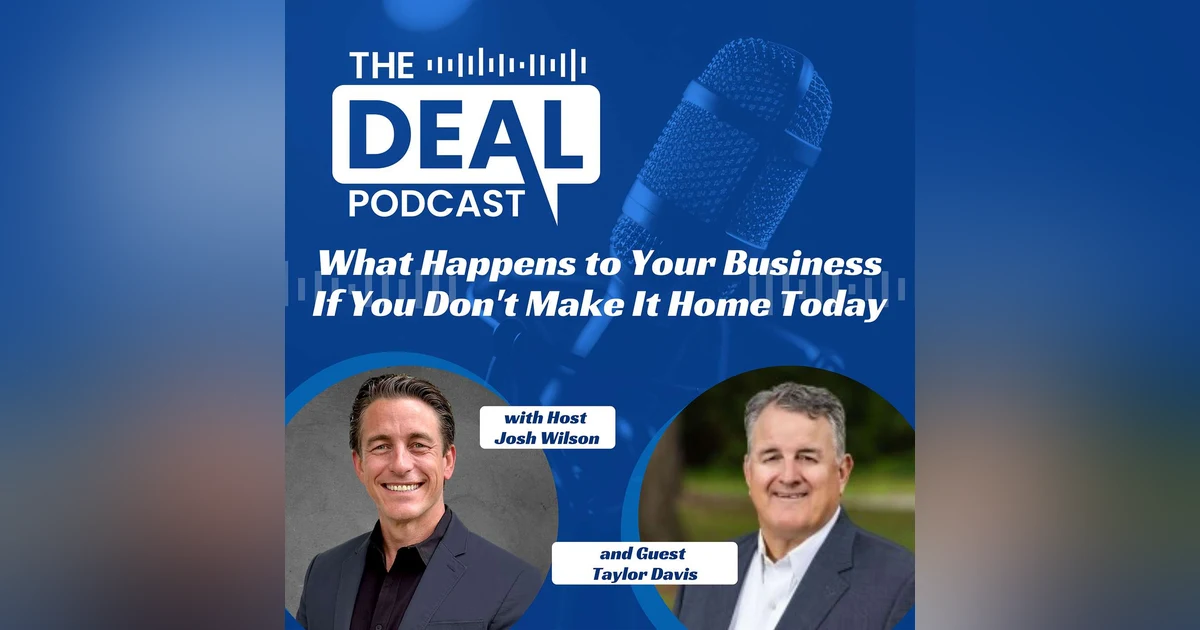

Taylor Davis on the buy-sell agreement for business owners — what happens when partnerships dissolve, why most high-income earners are underprotected, and the question every owner avoids.
Key Takeaways
- The most important question in any business relationship: what happens if you don't make it home today?
- Taylor Davis's father, a top vascular surgeon, died at 48 with almost no coverage after a partnership dissolved and the insurance went with it.
- High-income earners are often the most underprotected.
- Buy-sell agreements can break down when partners stop getting along.
What happens to your business if you don't make it home today?
Taylor Davis watched his father — a top vascular surgeon making great money — die at 48 with almost no coverage after a business partnership dissolved and the insurance went with it. His mother sold her dream home and went back to work. That experience became his life's mission.
Taylor Davis is a Wealth Management Advisor with Northwestern Mutual, approaching 34 years in the business. He works with individuals and closely held businesses on succession planning, buy-sell agreements, life insurance, long-term care, and charitable giving strategies. A multi-time NAIFA Quality Award recipient and Million Dollar Round Table alumnus, Taylor has spent three decades asking the questions most business owners never get asked — and helping families avoid the financial devastation he witnessed firsthand.
In this episode, Taylor shares the origin story that drove him into financial planning, the sales lessons from knocking on doors in North Dakota, and why the most important question in any business relationship is: what happens when you don't make it home?
🎯 What We Cover:
- Why high-income earners are often the most underprotected
- What really happens to a buy-sell agreement when partners stop getting along
- The question every business owner avoids — and why you can't afford to
- How to approach succession planning for a family business with kids in and out
- Why discovery never stops — even after 30 years with the same client
- The door-to-door sales lessons that still drive Taylor's practice today
- How to ask for referrals without feeling like you're crossing a line
- Long-term care planning and what COVID revealed about coverage gaps
- Charitable giving strategies that outlive the founder's wishes
- Why identity rooted in work — not faith or family — leads to bad outcomes
Topics: buy-sell agreement for business owners, succession planning for closely held businesses, partnership protection insurance, long-term care planning for owners, charitable giving strategies, family business succession, selling your business podcast
🤝 Connect with Taylor Davis: 🌐 https://www.northwesternmutual.com/financial/advisor/taylor-davis/meet-taylor 💼 https://www.linkedin.com/in/taylor-davis-b926564/
💼 Thinking About a Transaction? FA Mergers helps founders, investors, and business owners navigate the full M&A process — from valuation to close. If you're exploring a sale, acquisition, or capital raise, let's talk. 🔗 https://www.famergers.com/
🎙️ Follow The Deal Podcast: 🌐 https://www.thedealpodcast.com/
💼 https://www.linkedin.com/in/joshuabrucewilson/
▶️ https://www.youtube.com/@dealpodcast
DISCLAIMER The Deal Podcast is for informational and educational purposes only. Nothing discussed constitutes investment advice, a solicitation, or a recommendation to buy or sell any security. Always consult a licensed professional before making financial or investment decisions.
Disclaimer: Joshua Wilson is a licensed Florida real estate broker and holds FINRA Series 79 and Series 63 licensure. The Deal Podcast is presented by FA Mergers and is produced for informational and educational purposes only. Nothing discussed constitutes investment advice, legal or tax advice, a solicitation, or a recommendation to buy or sell any security or to pursue or avoid any transaction. All views and opinions expressed by the hosts, co-hosts, and guests are their own and do not necessarily reflect the positions of FA Mergers, One Iron Network LLC, any regulatory agency, or any employer. Listeners should consult their own legal, financial, and tax professionals before making any business, financial, or transaction decision. This podcast does not constitute a solicitation or recommendation for any financial products or services.
Frequently Asked Questions
Why does business succession planning matter?
Taylor Davis says the most important question in any business relationship is what happens if you don't make it home today. Succession planning answers it with buy-sell agreements, life insurance, and a plan for the business and family.
What happens to a buy-sell agreement when partners fall out?
Davis explains what really happens to a buy-sell agreement when partners stop getting along, and why the agreement and its funding need to hold up before something goes wrong.
Are high earners adequately insured?
Davis says high-income earners are often the most underprotected.
Who is Taylor Davis?
Taylor Davis is a Wealth Management Advisor with Northwestern Mutual, approaching 34 years in the business, working with individuals and closely held businesses on succession planning, buy-sell agreements, and insurance.
00:00 - Welcome & How Taylor Knows Jude David
01:44 - 34 Years at Northwestern Mutual
04:10 - The Question Nobody Wants to Answer
04:41 - His Father's Death & the Insurance That Vanished
13:57 - Door-to-Door Sales in North Dakota
19:19 - Identity, Faith & Why Work Can't Be Your Foundation
23:00 - The Art of Referrals & Reading the Room
33:05 - Sales Advice for Anyone Starting Out
37:53 - Highlights from 34 Years in the Business
42:05 - Succession Planning for Closely Held Family Businesses
46:40 - Charitable Giving & the Lourdes Foundation
51:57 - Finding Your Path & Taylor's Own Succession Plan
Welcome & How Taylor Knows Jude David
SPEAKER_01
Good day, everybody. Welcome to the Deal Podcast. Um, this show is brought to you by FA Mergers. We sell middle market companies, right? That's our joy. That's why we do it. Uh we started this podcast specifically to uh do two things. One is to inspire the future generation of deal makers and entrepreneurs. It's hard out there. It's hard to build a business, it's hard to grow a business, hard to sell a company, right? So as we seen and heard a lot of stories, we want to share these stories with these entrepreneurs who come in and who have built a company, sold a company, or who have maybe been on the other end where they're serving these companies on a day-to-day basis. So that's one of our missions. And then we love deals. So if you have a deal that you'd like to talk about or maybe a company that you'd like to sell, head over to thedealpodcast.com, fill out a quick form, and someone from our team will connect with you and maybe do a deal. Um, Taylor, you were brought in by Jude to, you know, come share what you do and your mission and ministry and and the things that you, you, and your family participate in. Let's start with this. How do you know Jude and uh the team here at FA?
SPEAKER_00
So uh I I've known Jude since uh we're we're family friends. His dad is Paul and mom Marla, and they uh were very good friends. My brother's uh Hampton is a Catholic priest here in in Lafayette Diocese, and uh they they became very close. I'm pretty sure he's baptized a few of them, a few of the uh David kids, maybe even married a couple. I'm not I'm not quite sure. Uh but uh Paul and Marla are just wonderful people. Hope you get them on the show one day. They're just fabulous people, and um so that's how we we've gotten to know each other.
SPEAKER_01
Yeah, man, that's fantastic. Um Lafayette, tell us a little bit about you know who you are and what you do here in Lafayette.
SPEAKER_00
So I'm a financial advisor with uh Northwestern Mutual. It'll be 34 years and uh April 15th. Uh great, great date, isn't that? April 15th. Yeah. Uh next day. Yeah, yeah, yeah, yeah. And um, you know, it's a it is a hard business, I gotta say, you know, uh there's a lot of turnover in our our business as I see it. So I'm I'm I'm proud that I've made it this far and uh and built this uh built this practice. Um you mentioned Lafayette. Uh I absolutely love this town, and I hope we'll get to have some talk about that kind of on the tail end of this. But my practice is I work with individuals, closely held businesses on planning, um, whatever that may be, buy-sell planning, um, you know, uh succession planning, uh charitable giving, uh, whatever their uh needs are, we are there to uh help them with a lot of questions. You know, I I I I find I've been in many of my uh you know meetings with folks and and they'll say, no one's ever asked me that question, right? Yeah and so we we we continue to discover. Uh I might have a client for 30 years and I'm continually asking him what's going on or her, what's going on, what's changing in your life that can affect your plan. And um, and so we're continually in discovery uh in in our practice.
The Question Nobody Wants to Answer
SPEAKER_01
So, Taylor, as as we get to know each other and spend some time together on the podcast, um, you know, my my job is to ask questions and then listen, right? So I love it when I hear someone say, Man, that's a good question, or no one's ever asked me that before. And, you know, like that, that's how I know as a service provider, providing stories and and um, you know, transferring wisdom to people. Um, what are some of the questions that you ask these business owners and business leaders that they might not be being asked by other financial advisors?
His Father's Death & the Insurance That Vanished
SPEAKER_00
Well, I don't know if they're not being asked by other financial advisors, but I I straight up say, what will happen to this business if you die today? If you didn't make it home today, what's gonna happen to your family, to your business? Um, and I think people um ultimately they don't want to have that discussion because it is a there's a morbid factor to it. But the reality is, and the reason I I got into this business, my father died at 48 years old. He was one of the he was a first vascular surgeon here in town. He was making a lot of money for the for that for that era in the late 80s, mid-80s, and um, and he he died of cancer. And so I I we I'm one of eight kids, and I know what the effect of his passing was that early to our family. And I continue to know that. And that kind of gets me up in the morning to know, hey, this happens to folks, and uh I'm not you know, our plans are what happens today, but we also and we also talk about what happens tomorrow, right? And if you do live till 89 years old, how's that gonna work? Uh could will you have enough assets to do that? Uh how do you want to leave your assets? So, yeah, those are some of the key questions.
SPEAKER_01
Yeah, let's go to this or origin story of yours. Uh one of eight kids here in Lafayette. Yep. Here in Lafayette, dad was a doctor, cardiovascular surgeon.
SPEAKER_00
Correct.
SPEAKER_01
Making good money, right?
SPEAKER_00
Great money.
SPEAKER_01
And, you know, the doctors out there and you know, the the high paid uh workers out there, you know, listening in, they're like, oh man, I'm making a ton, you know, I finally paid off my school loans or working my way towards that, you know. The the thought is I could continue doing this for at least, you know, 20, 30, maybe 40 years, right? So like I've got time, and that's not guaranteed to everyone. So how did it impact you and your family when dad passes at 48 years old?
SPEAKER_00
It was a huge impact. Um he had uh done some planning himself through some a partnership he had with two other doctors. Those two doctors didn't like each other, so they blew it up. They didn't like having insurance owned on each other. So a lot of their insurance that they had that he had planned personally was in that package, and he got rid, they they blew it up, they canceled a bunch, and he never got around to fixing that. And um he had not a lot of coverage, uh, and we he was, you know, like I said, he was making a great income, and it certainly wanted being protected. So what happened? My mother had to sell her home, my mother had to go to work, and a lot of incredible stuff came out of that. I'm not saying it was all bad, but I know that the little that I knew about my father, I was only 17 when he passed, he took care of my mother, and that was his that was his goal. And I and you saw it through the way we lived and the way that um and so I know that was not his plan. Uh his plan was not that she would have to sell her home, that her dream home, and and and go through a lot of that uh uh financial stress, if you will, as a result of uh his early passing.
SPEAKER_01
Yeah. So you were 17 years old. Where do you fall in the stack of eight kids?
SPEAKER_00
I'm the sixth. I have two younger sisters and five older uh brothers and sisters.
SPEAKER_01
Okay, got it. So what is the oldest? How much how much older is the oldest, and how much younger is the youngest?
SPEAKER_00
Like uh, we're like between 67 and 50. Okay, got it.
SPEAKER_01
So pretty pretty tight for for that many kids. Yeah. Um, all right, so you're 17 years old, maybe senior in high school or just finishing up.
SPEAKER_00
Sorry. 56. Sorry.
SPEAKER_01
Okay, got it. Yeah, no worries. So you maybe senior in high school when dad passes. Um, you know, as as you get this news, the the phone call one day, or maybe it was maybe it was a a degrade where you you knew it was coming, but when that that day happened, talk to us about what was going on in your heart, your mind, um, and your family.
SPEAKER_00
Josh, I was 17 years old. Uh bit of a moron, you know, just just because you know, I I I wasn't you know involved in school and all those different things. Uh sports. Uh my father, even though he had this incredible um schedule, he showed up. He showed up at games and things like that. So you can imagine it was a it was a huge transition. Uh my mother, Beverly, was just sh incredibly strong, and she taught us so much through this. So, you know, there's always some good and and even bad, right? Sure. And as sad as that is, there was many, many graces that came through that. And one of those was this woman stepped up to the plate in a in a in a dramatic way and really continued the promise of of of our of raising us. Uh and they say it never stops. I truly believe that. Uh and and I'm a father now and it it never stops.
SPEAKER_01
Yeah. Taylor, um, you said your mom went back to work. She had to sell her dream home, right? They they built a home together, you know, they've got through med school and they got through the years of residency and surgery, blah, blah, blah. I mean, tons of time. And then you always have this future of like, okay, cool, we're gonna build our dream home. It's gonna be our biggest asset, like, we're gonna really do this right. We're gonna raise our kids here, our grandkids here. And then um, dad passes, the insurance thing between the partners wasn't planned out well, or maybe just bombed, and then mom had to go back to work and sell the home. What did she go to do? Like, what kind of work did she dive back into?
SPEAKER_00
It's amazing. She she went to work for a uh retail place for a second and realized this wasn't it. She became one of the top realtors in town. Okay. Uh, and she was a student of the game. And once again, that's one of the graces of this is watching my mother work. Um she was a student with she she went to every class, and and if they said this works, she worked it. Yeah, and so uh yeah, she became uh and really replaced uh that that income that she was used to through through that through that occupation.
SPEAKER_01
It's it's amazing how many stories I hear where need, what did it say is need is the necessity is the uh father of invention, right? And you know, innovation. And uh it's amazing when we uh go through a a struggle, a time of change where the the things that pour up inside of us really uh really shine through or the potential to do that. So, you know, you saw your mom step into the world of you know, service provider as a real estate agent and and professional there. What did you want to be when you were graduating high school? Like what did your future and plan and your dreams look like?
SPEAKER_00
I thought you said you weren't gonna ask those hard questions, John. Let's go. No, no, no. I really had no idea. I was I was that kid, I I was that kid that probably shouldn't have gone to college at the at the first part. And I didn't. I I did, and then I I dropped out and started and went and worked and realized, hey, this is you know, what what did I want to do with my life after doing some manual labor things, you know? And uh ultimately I I knew as a people person I could do sales. And uh when I finished school, um I I I I finished in Tennessee at Middle Tennessee State University, go Blue Raiders, and um and I I came back and some mentors here uh in in town and talked to them and uh and this kind of fell in as to a natural because you know, a natural calling because of what happened to my father. And one of those mentors worked at Northwestern Mutual, a guy named Chris Gamble, who was just this incredible guy. And uh he it was pretty interesting because I'd never really I'd done retail sales, but I'd never done hardcore pick-up the phone sales. And so he talked me into um going to sell books door to door after the year I the summer after the year I got out of college uh to go get experience before I started with Northwestern Mutual. And that was critical uh to understanding you know the numbers of folks you have to talk to because it's all about timing with people, and and you have to be in front of people to to create the need, or not create the need, but understand the need and see if they're in a good place to do planning. And so it's you have to talk to a lot of folks to to make it work. Yeah.
Door-to-Door Sales in North Dakota
SPEAKER_01
Um let's let's do a little role play. You know, we we talked to a lot of people, and uh we've heard a lot of stories of people who had to go sell door to door or had to, you know, we just interviewed the the guys from uh gingerbread twins, and you know, they they would take the cakes and they would walk around or they would sell cookies at you know with their but sales is such a vital aspect of um of business. So let let's do a little fun game here is uh remember your door knocking? Oh yeah. All right, so you're gonna, you know, still have nightmares. I I I hear you. All right, so you you knock on the door and you know someone opens the door and and what was your do you remember your pitch back then? Yeah, go for it.
SPEAKER_00
Oh yeah. Uh knocked on the door. I was up in North Dakota, and there literally were no locks on the door. So I would just walk in.
SPEAKER_01
You'd walk into people's houses.
SPEAKER_00
I would walk in and uh and and they they were like, excuse me. And I was like, Oh, I'm sorry, the door is open. Uh Mrs. Jones, how are you doing? I'm Taylor Davis, I'm with the Southwestern Book Company. I'm out here working for, you know, working this summer, and I just want to come and introduce myself and tell you about what we do. And and it was incredible. I mean, North Dakota, the people were so nice. Yeah, and it was rare that you know you would get anybody upset about that. Now, you know, obviously uh I wasn't walking way deep into the situation, but the doors were open. It was I would tell folks that and uh you know in our in our network and they're like, what are you talking about? I'm just saying they they didn't have locks because there was there was really no no crime, or I guess. And um and that was it. And you you know, they were either in a good time to do it or not. Yeah, and uh, and it was fun. I mean, you know, it was it was hard work, lonely work out there, but it was it was interesting.
SPEAKER_01
If you did that in Tennessee, Louisiana, or Texas, you might get shot. It put you in jail, put you in jail, yeah. Man, fascinating. The uh Hutzpah, the the guts you have to have to invite yourself in and and do that. Were you always inclined to be able to sell or or ask for, you know, an opportunity or or kind of go walk in someone's house?
SPEAKER_00
You know, I I I I you know, we recruit a lot of folks, we talk to, oh, he's a people person. The best salespeople, uh the best guys in our business are are true educators, right? They know they have to touch so many people to educate, but they're not necessarily big people people. So it it wasn't, you know, I just mentioned before, I th I thought I would go into sales uh coming out of you know out of college and all. I knew I wasn't gonna be a doctor, a lawyer, CPA. And so I had to find that place. And I think everybody is selling. I don't care what you do. You you know, the doctor says you have cancer, we're gonna do this. They've got to tell them why. Why are we why are we doing this this procedure or whatever it is? And so it's all about education. And so, yes, the sales part is getting to those folks to talk to them about it, but the next part is educating them on the process. And so, like I said, some of the best guys I've I've seen in the business are uh introverted, not extroverted. Really? Yeah.
SPEAKER_01
So, but knocking on the door, I've had to do door-to-door sales, it's tough. Yeah, right. They they say the hardest door you'll have to ever get through is your car door. Getting out of the car and knocking on a door is sometimes brutal because uh, you know, you might be struggling financially. You might be going through issues at home with a spouse, or you might be going through your own junk in your brain. Knocking on their door is tough. What advice do you have for people who need to go knock on some doors or cold call people? Or, you know, like out of the blue.
SPEAKER_00
The best advice I ever received was in the first day of training at Northwestern Mutuals guy Roger McChesney. And I, you know, I want to tell you about mentors too, because it's so important. But A to have mentors and to be a mentor. And I want to make sure that is that is so critical. Uh and I know uh as I listened to y'all show, I heard that, and and that that be open to the mentorship. And I know time is busy, uh we're busy, but it's it's just so important. But he said, you have people in your life that will love you regardless. You have your family, I'm one of eight. I had my mother, I have a few friends, close friends. Those people are gonna love you regardless, right? You just have to know that you have your support elsewhere, and it's not gonna be out of this call, right? Now, you may develop a relationship, and I have had many, many relationships. I mean, my wife has told me quit bringing new people home because it's it's so wonderful, right? But that that's what I would tell folks is that these folks that are saying no to you are not saying no, they're saying no to time. And it's okay. And it's just understanding that you have to go through that process. And that was the best advice that I got is I knew I had my network. That regardless of the five cancel appointments I got that day, that I could pick up the phone and call my brothers or my sisters or whoever, and they were gonna love me where I was. And so that that was critical to me.
SPEAKER_01
I want us to harp on this because I I think a lot of times uh visionaries, founders, uh business owners, business leaders, they sometimes we we create this identity, persona, this uh codependency on our work. And you'll see this with business owners who just stay in it forever, forever, right? Like Sandlot movie. Because they're they're so much wrapped up into that business and their identity, their their approval, their validation. You're saying, this is what I hear, I'm repeating it back to you. You're saying is you get that from your home. You get that from your relationship with your community, you get that from maybe a relationship from God. Before we hit record today, we prayed. What when you show up to work, you gotta come with a full cup, right? You gotta come with that's not where you get your approval and your validation from, that's not where you get your identity from, that's not where you get your what what's in you from. You're going there to teach and to serve. Is that what I heard?
SPEAKER_00
Amen.
SPEAKER_01
Yeah. When you get that wrong, and you have seen hundreds, maybe thousands of business owners over the years, when you get that wrong, how does that show up in life planning, succession planning, business planning?
SPEAKER_00
Look at the divorce rate. Look at the you know, the the non-success of new businesses. You know, I I think when it gets out of whack and you you you don't have that core, uh so many things can go wrong. And I've seen it time and time again. Uh so I I I I believe that if if that's your core identity and you don't have that other foundation, it it can be very tough. And I've seen it. And I would I would add that I do personally I I love to serve, and and and I believe that in in that service is is also the the ability to help folks, right? It's isn't my identity? No. It's it's part of what we do uh in this community.
SPEAKER_01
Yeah. Man, so good. Taylor, you went from you know, breaking and entering in people's homes to sell them books to to financial planning. Uh so you had a mentor who worked at n you know Northwest Mutual and he said, I really think it's a good idea for you to go knock on some doors, kinda get some in the field training, get your teeth kicked in a little bit, get some rejections, get some sharpen your skills and then I think maybe financial planning is in your future. Is that how that went? That's how it went. Cool. So you show up at work and they they give you a this was back in the 80s, then no nineties.
SPEAKER_00
Uh yeah, nineties.
SPEAKER_01
Okay. They hand you a phone book essentially and a and a phone, a rotary phone.
SPEAKER_00
Our culture is based on referrals. Yeah. So they say come in with two, three hundred names first of people you know. And it's not very hard these days, right? Yeah. With social media. And uh and then part of that process is asking for referrals. So it's very rare that I'm cold calling. I I I just never did that. Uh as the only really cold calling I've done is knocking on doors. Cool. Uh when we did that. So it's rare that it's cold. Uh I like it. Warm, warm, warm.
The Art of Referrals & Reading the Room
SPEAKER_01
Same, same, same. Um, let's talk about referrals because I think a lot of times, like you and I build a relationship, we become friends, we go golfing together. I don't golf, but we Scott, and you go golfing. Yeah, I'll sit. Listen, I'll tell you my specialty in golfing is I will drive the golf cart like a champ. And I'll sit there with a cigar and I heckle. That's my specialty.
SPEAKER_00
There you go.
SPEAKER_01
I'm really good at it.
SPEAKER_00
There you go.
SPEAKER_01
And I'd make the people with me better. So I'm I'm more of a golfing heckler.
SPEAKER_00
We don't want to go down this road. I could go way far with the golfing, so let's not go there.
SPEAKER_01
Well, if Scott were in here, uh, who's a scratcher? Next time we record, we'll record on the golf course and we'll see. Let's go. Let's go. And I'll heckle. So where the heck was I? All right. So uh one of the things that I love talking about, you know, from the knocking on doors and having conversations and doing the cold calling and all that stuff. I love talking to salespeople. One of the things that I find is super hard, especially after we build a relationship with, is asking you for business. Right? And then asking you for a friend to give me business. Because then I'm like, oh shoot, we just entered the friend zone. I don't do business with friends, I don't do this or I don't want to look needy, I don't want to look less, I want to look like I've got it all together.
SPEAKER_00
Right. Well, what I've learned is some people give them and some people don't. And how do you know unless you ask, right? And so it's just part of the process. And when I know that they don't, I never I don't ask them again, right? But I have clients that could just continually send me business. I don't even ask. They just say, oh, you have to talk to Taylor uh about that, you know, when they're having that conversation. And so yeah, it's uh it is hard. And I'm not saying that it it it was easy, because it's it is hard. It's probably and also you you go through the whole process of of making a client, and it's you're tired at that point, and then you got to go one more step. And so, but it is one of the it is probably the most important step. I tell people, new guys in the business, this is 90% of what we do, 80% is prospecting. You have you have to prospect. The knowledge, the planning, it's all right there. You know, we have such good training, such good tools. It's it's all right there. But the work is in prospecting.
SPEAKER_01
Yeah, but I don't think, Taylor, I know that you love people. I know that you got into it because you have a family story of like, man, I I experienced some pain with you know growing up when dad died, mom had to go back to work, had to sell the house. So like you had this like not chip on the shoulder, but you had this like past painful experience, and you go, I'm gonna make sure that that doesn't happen to other people. You had a purpose. And I think when salespeople go out knocking on your door, cold, calling, or asking, it's because they had a story and a purpose. What about someone who shows up who doesn't necessarily have a story and a purpose? How could they become successful in in sales?
SPEAKER_00
I I there's so many books, there's so many uh steal a story, you know. I don't want to be ingenuine, but um it it if you just get out there and ask folks, you know, I I do long-term care planning, that's a great example. And the first thing I do is do you have any experience with helping a parent or grandparent through their uh losing daily activities of living? And tell me. Because if if they don't, this is going to be a hard uphill battle, right? With regards, but if they do, it's unbelievable. So I I want to hear people's stories of their parents dying earlier, their someone dying in their company, or being disabled, or or any of those things that need to be protected. So that to me is the is the is the question. And once folks tell you that story, then we can kind of go through a plan that that would help fit that situation, right? Uh and in uh in co during COVID, so many folks um in need of care couldn't get it because folks weren't leaving their home. So family members had to leave their job and go and and take care of folks. Yeah. Some of our policies paid those family members to do it. Yeah. That was pretty cool. We had that had never that hadn't been done. And so we were able to do a pretty cool uh pivot in COVID when that happened. And that's all about, hey, what's going on? The they they won't show up, they won't come, they're scared of COVID, right? The caregivers.
SPEAKER_01
So when you meet someone at on the golf course, country club, or you know, uh an event, you're gonna talk to us soon about you know charitable giving and you know some of the work that you guys do there, and that that's really cool. It's part of purpose. But when you you meet people and they're like, you're like, hey, I'm I'm Taylor and I do, you know, I'm a financial planner. Do you feel like do you feel like people will either lean into that or do you feel like they're like, oh no, I hope he doesn't sell me or I hope he doesn't do that? Is there that kind of uh feeling when when meeting people?
SPEAKER_00
I I I feel like it's all about reading the room, right? I I I love the club where I play golf, right? I don't bring it up. I don't think it's the place. People will come up to me and say, hey, give me a call, but I don't bring it up. I've had folks in my career and seen them do it, and it's so uncomfortable. It is. It's all about reading the room. And to me, it's about relationships. So if I'm like my brother and I used to talk about, if you spend four and a half, five hours with somebody, you're pretty much gonna know if they're gonna kill themselves the next day, right? You're gonna learn a little bit about them. That's what it's all about. It's and so those I I I I don't because I don't I won't allow myself to make that pressure on them, right? But if those ask me what we do, you know, I it it it it's it's a uh it's reading the room, you know, and being being uh genuine to that.
SPEAKER_01
Yeah. They call that uh EQ, right? There's IQ and EQ. IQ is your you know how smart you are. EQ is how well can you understand your emotions and other people's emotions. It's an emotional quotient, right? Being able to read a room, being able to read a person, being able to have a conversation. And I think some people are better at it than others. I think you're fantastic at it, right? Like well, we'll see good days and bad. Yeah, we'll see how this interview goes. Yeah, yeah. But Taylor, um, you just said the most important and step, you know, step in sales is asking for referrals and prospecting. I think a lot of sales organizations are gonna go, cool, get into a church and then do an altar call and then try to sell them stuff. Go to a country club, get a restaurant, get these memberships, go to these groups and sell, sell, sell, sell, sell. Always be closing, Glengargi, right? You say you really don't bring it up unless, you know, you read the room, but like, all right, how do you balance this? You have to be prospecting all the time, but you also have to have some friends and some community where you're just not pitching all the time. How do you balance?
SPEAKER_00
It is a balance. It is a balance. And uh I I told you about the warm call. You know, if I my child was in a school and I we met the parent and we really liked him, eventually I'm taking them to lunch, you know, and hey, let's go to lunch. Talk about what you do, what I do, right? And so that's how I do it is um over time um is is have that introduction. And uh, and if it if it's a fit, it's a fit. If it isn't, we're still gonna be friends. That that's part of the thing, is at worst, you're gonna make a new friend out of this, right? And so that I I believe that's happened many times. Look, when my wife finally figured out what I did, because prior prior primarily was life insurance and insurance planning when we started this, um, she kind of went to tears. She's like, we're not gonna have any friends. And I'm like, you're gonna one day tell me to quit bringing people home. And it's true. We have so many relationships, you know. Are they all clients? No, they're not. And I and it's fine, you know. And so I think it's important. You do y'all get every deal? No. I mean, you you you said it yeah on this call, you know, go to our site and fill out some paperwork. Are they all going to be a right fit? No. No. And uh so I I I I went to this opportunity machine the other day. I don't know if you've heard about it, but it's it's a business incubator in town. And they just built this beautiful facility down. I'd never been. And uh and I said, What's one of the most important things y'all do? And he said, The most one of the most important things we do is we tell people this idea won't work. Right? Meaning they're helping them understand how hard it is to start a business. Yeah, and I what they're asking questions, are you willing to do all these things to start this business? And I mean, think about it, that's the most important thing. And it's but their business is to incubate business, so it's opposite of what they're they're doing, right? Yeah, but it's true. They're incubating some incredible businesses over there, and so I think that's so cool. Is is everybody gonna be a client? No. Uh, will it be the right time? No. And that's part of kind of learning about that.
SPEAKER_01
Yeah, man, I love it. I and I love talking about sales. Um, the art of sales, the art of persuasion, the art of conversation. Um, for someone new getting into the world of sales, maybe gonna start out their own book of business and financial planning or some service-based business where it's you know, relationship driven, referral-based. What is some of the early advice you have for them? Is it go knock on doors? Is it, you know, what what what do you think?
SPEAKER_00
I believe that the the group you're going, if it's gonna be totally brand new, get some training somehow. You know, you have to find some training somehow. You have to coach your salespeople, you know, if ultimately you're gonna be building some account of organization. If you're working for an organization that clearly has had success, do what they tell you to do. That's that's where we get off course. They're telling you what to do because it worked. And it's probably hard, right? But that's that's that's the advice I give the guys in our in our world is hey, don't start recreating the wheel, right? And and that starting off new, I tell you, I don't know if I have a lot of advice. I listened to your show with Gus Rendende Rosende's the other day, and whoo, all those guys. Yeah, I mean, that that true entrepreneurship, right? Yeah, I I am not an entrepreneur. I I I went into something that was built and I was able to plug myself into and work it. We worked it, we're working it, but those guys, I mean, it's it's that was pretty wild. He he's amazing.
SPEAKER_01
Yeah, shout out to Gus. Yeah. Um, yeah, as this is interesting. I because I think that there's some people who go, cool, show me something that has worked. Show me the process, show me the system. I'll work the process. Uh, you know, and you know, like I trust the process, I'll work the process. Show me what you've done to be successful. There's definitely that mindset. There's other people, probably like a Gus or you know, others who that we've had on the show, who would hear something and go, that's cool, I'm gonna build a new wheel. Right? There, I I think that there's some difference. Um talk to us about the way your brain approaches, like, okay, I'm gonna trust the system, work the system, and do that. But as you have done that looking back 34 years in as a financial advisor, if you, you know, if you could go back and tell yourself, hey, try this instead, then maybe it would have changed your trajectory, what would you have done differently?
SPEAKER_00
I would have made 10 more calls a day. You know, honestly. From a prospecting standpoint, if I, you know, if you're gonna ask me that question, I would have made 10 more calls, right? And I didn't, so I you know, you live with that, that, that, the end of that. But it I think it's uh, you know, and and you have to, like today, uh the marketing piece, we've plug, we're plugging in, you know, we're doing social media. I'm hiring folks to help me with that. Uh we're using the tools that are available, uh, but the but the at the bottom of the at the you know, at the core of the deal is you've got to pick up the phone. I don't know. One of my favorite books I'm looking at right now is called Pick Up the Phone and Sell. And you read this, and it's just common sense. And it's about, hey, people don't want to be text and they don't want to be emailed right now. It we need to go back to the core of picking up the phone. Yeah, and there's a whole uh sales um uh I think what what do they call it? Uh anyway, the book is great, uh, but it's common sense. People do want you to hear from you. And if they don't, they're gonna tell you. Yeah, and that's all about that's what I think is getting permission. Getting permission, right? Because we start dragging people down the road, and at the end of the day, I'll say, look, I thought you gave me permission for this. Apparently I didn't. And you're busy, I'm busy, let's just call it a day. That's okay. Well, when you're first starting out, that's hard. That's hard. You know, you you got that, oh no, I don't want to do that, but that's a great lesson.
SPEAKER_01
Yeah, asking permission to because it's every yes, there's a if you break it, if you if you break down every yes, there's a series of micro yeses to get to that one yes. Could we hop on a call? Can we go out to coffee? Could we go out to lunch? Can I get a few minutes of your, you know, like there's do you even want to talk to me?
SPEAKER_00
Right.
SPEAKER_01
To get to that first yes, cool. Then you have to, you know, there's paperwork, and then there's filling out know your customer, and then there's all of this stuff before you even get to make money and do stuff. Right. Yeah, any any big yes has a a series of micro yeses, and at any point that you can you can lose the deal. When it comes to you know, the the work that you've done, give us some highlights in terms of 34 years of doing this in the business. What are some of the things that you've maybe accomplished or are proud of that you know, from from being in this industry?
SPEAKER_00
Yeah, I I I've just got some wonderful clients that uh I that have grown, and it's just been so cool to to see that, you know, from a$55,000 annual salary to a guy making a million dollars, right? That and have the core values come along with it, right? Their family, their faith. Uh those are just so fun, you know. Taking those calls, we service a lot right now, right? And I I like doing it just because we're we're in contact, right? And uh this and and so that that's incredible. Um I have to tell this one story. My brother died in 2020, 60 years old. And a lot of people knew him. He was incredible. He was an attorney, turned into commercial realtor, Hammy Davis's name. And uh I get a call from his wife, said, We're paying too much on this, on this, on this insurance. We need to come in and get rid of some. I said, Come on in. Let's, you know, we haven't visited in a while. Um three hours later, he bought some more, right? And this was two years before he passed away. And I tell the story because he still needed that, right? But they didn't see the coverage, they saw the the cost, right? Two years later he passes away. Do we know that was gonna happen? No, he got a perfect rating, you know, health-wise, right? And I only share that because, yeah, things change, um, but you know, the the we we just have to have the conversations, right? And it's it's all in the planning. And I talked about early on the discovery, constant, constant discovery. What's going on, what's changing your life? And I think the good guys that are doing it well are doing that. It's continued contact with their clients and and discovery.
SPEAKER_01
Yeah, one of the uh things, a common thread, a common conversation that pops up here is how to have tough conversations, right? Nobody wants to, hey buddy, how are you doing today? Man, I'm great. What are you gonna do when you die? Yeah. You're like, what? What happens if you're you know, if the breadwinner of the family dies, or your strategic partner, the key men in the comp like, what happens when they die? Like, oh my gosh, like that's momentum more, like the the the man, death.
SPEAKER_00
Yeah.
SPEAKER_01
Who wants to talk about that all day? What are some things that you can, you know, as you think through how to how to approach those conversations, like how do you do that?
SPEAKER_00
And I I mentioned it earlier. What has your experience been? Because every everyone has had someone die. And so that that's what I draw on is uh and if they need a little help, I'll tell them my experience, right? And and so I given I've given two pretty pretty dramatic examples today of uh of my life and how it's affected my life, deaths in my life. Um and so yeah, and once again, it's it's asking the permission with those folks, is this the right time to have this discussion? Because it I don't know, I really have I like to have I like to do this in November for the holidays. That's when I like to know great, I'll call you November, right? And so yeah, I think that's that's the key is drawing on your experience. Um, and then if you need some help from my experience, that's been very fruitful for me. Yeah. And my clients.
SPEAKER_01
As you're working with, you know, business owners, you you've been in the business long enough where you've seen full cycles of, hey, I'm starting out to, hey man, we're starting to look to exit. And you know, what's gonna happen? Tough question is what what are you gonna have, what's gonna happen to your business when you die? Or what's gonna happen to your business when you want out of the business or you want to hand it off to a kid or uh uh your employees through whatever. Like let's talk about like the end of their career in that planning, succession planning.
SPEAKER_00
It's so uh interesting. It's my favorite thing to work with closely held businesses. You'll have a prime example, mom and pop, they started the company out of the garage. Um, you've you know, we've all heard that story. They have five kids, two kids are in the business, three kids are out. Um, they want the two kids to make to have the business, right? And so it's a matter of understanding what they want. Well, the other three kids, we want to get them taken care of. Well, oftentimes it's hard to keep the business from a liquidity standpoint and get the other kids taken care of. So what's a great solution? Life insurance, right? And so I'm I'm short, short, shortening the process, but that is a team deal. I may have discovered that, but the CPA has got to come in. The tax attorney's got to come in. So it's a true team thing, and it's a long process. And so that's what I tell these young guys look, we I can help you with these things, but it you need to let us come in and start the discovery and go find some other folks, and we'll we can work these cases that take a long period of time because it just does. Valuations are critical. Many companies haven't gotten valued. Um CPA has done a little, you know, side side deal, but you know, if you're going to transfer a company to kids, you got to sell it to them. And so uh the valuations become very key. So it's a it's a process, and I it's my favorite. I I love doing it uh because to see a company stick around after the matriarchs have passed, uh, that's a big deal. That is a big deal.
SPEAKER_01
I love I love this conversation. Um, you've probably seen when people held on To the business too long or that haven't built an actual business, they've just built a job, a very successful job, and then so and so dies or gets sick or something like that. When it comes to that succession planning, the question I think the number one question that the business owner has in their mind is when is the right time to have a conversation about succession planning? When is the right time to sell? Like that I think that is always plaguing them in their brain. They might not admit to it, but that's what I've heard. What walk us through that?
SPEAKER_00
Well, like I said, it's everyone is different uh from a perspective of when is the right time. Um one of my favorite clients, uh, they started that process and got so confused, and this was like 20 years ago, 15 years ago, they got so confused uh with the legal, they just quit, right? And somehow I got referred into them as a new relationship, and the matriarch and I sat down. She wanted to open up an account for her grandkid. That's why she was talking to me. And I said, I'm happy to do that. But tell me what y'all have done on legacy planning on your succession planning. Well, we haven't done it. I said, How can I help? You know, and and and she basically I said, What happened? And they told us experience. I said, Well, if I can make that a little easier, would y'all be uh open to uh to uh to another path? And they did. And we we got another attorney in, got the legal pad out. What do y'all want to have happen? This is how we're gonna map it out, and we've we mapped it out, and it's we've saved them a ton of money on a state on estate taxes. Obviously, that changes year to year to year, and it's gonna the company's gonna is gonna go to where the kids need to go with plenty of liquidity, and the other kids are gonna be taken care of. Yeah, yeah.
SPEAKER_01
That's special. I think you know, as we're building businesses, like the reason I'm building is because I have three beautiful kids and I want my wife taken care of, and I want to lead the world in a better place, and I got a lot of heart to invest in people and but also giving. Now, your your wife's involved in the world of giving, you're in the world of giving, you work with people all day who have this idea of like, cool, let's take care of the kids. I might not have kids. Let's think about giving. How does that show up in your world and in your family's world?
Charitable Giving & the Lourdes Foundation
SPEAKER_00
I tell you, you know, it it it's in our in the planning world, um there's there's so many ways you can do it, right? And so I would say that most of the planning is being done, you know, wills, trust, taking care of the families, right? Making sure the powers of attorney, all those different things, taking care of the family. And it's a lot of work, and I told you that before. At the end of the day, asking for a referral, you know, they're tired, we're tired, right? Well, it's just a matter of asking those folks what's what else is important to you? What else at the end of the year, or when do you do your charitable giving? What is that really important to you? And how are you doing that? How are you doing your giving, right? And then can we show you some strategies that might work better for that? And do your kids align with you? Meaning, if you die today, are your kids going to continue supporting those organizations? Probably not. And that's been my experience. They the kids have their own things, right? And so there's an education that goes along with that. And you have the ability through the Catholic Foundation, Katie Anna Foundation, uh to set up trust and and and private foundations, different different strategies, so that those gifts can continue on regardless of what your kids want or not, uh when you're when you're gone. And so it's so cool. But it's once again um taking the time to do it, right? And and it's it's after I've done all this other stuff, it's one more level of planning. But in this this area, the the giving is incredible. I I have to tell you, it's rare that I ever go out and ask that someone doesn't give, right? And I I think that's the cool part about it is having folks understand that uh their their families are taken care of. I'm taken care of. This is the extra. What else can I do with it and leverage the extra?
SPEAKER_01
Here's your opportunity to get some brownie points. You're gonna get an opportunity to talk about your wife and her mission and uh why that's so important to you guys. Go for it, bud.
SPEAKER_00
So uh I was missing my wife today, she works for the Lord's Foundation, and they do just amazing work in this community. St. Bernadette's Clinic, they serve the poorest of the poor. Um many people don't even know about it. Um they uh the clinic does dental services, they have a foot washing uh ministry. It's it's just incredible. And when I tell you it's a the poorest of the poor area in our town. And that they they just uh I was talking about it because they they engaged a group that uh went very deeply into this charitable giving and understanding that people aren't really that interested in the strategies. They they want you to be interested in what they're interested in. And this guy built this whole company on being hired by a charity to go out and talk about it with individuals and to help them formulate it. They don't do documentation, they want you to go to your attorney in town, so they're not and they they want you to get a help you get a plan. And I think it's just brilliant what they've done. And so, yeah, uh their Lord's Foundation is doing great work, and uh my wife is is working really hard to to help folks with the message of charitable giving and and not just their uh charity, but I think when you get the message out, I know when you get the message out. We had this guy, David Como with ULL Foundation locally, who was one of the first guys getting the news out about it. He went to University of Florida um to in their planned giving uh he got a master's in it, comes here, he just blanketly went everywhere to talk about it, to all the different, and the fruits of that have been amazing to ULL, but also to other to other uh entities. If you're telling that story, so that's the cool part. That is super cool. Yeah, yeah. Uh Dave Como, rest in peace.
SPEAKER_01
Yeah. Related to Brady Como?
SPEAKER_00
There's so much there's so many Como's. It's like Morrison in Florida.
Finding Your Path & Taylor's Own Succession Plan
SPEAKER_01
Yeah, yeah. One of our uh great joys is uh the in-studio guest, when I remember to to do this, get to pass on a question to the next guest. Uh Dominic Dupree came on, and uh one of the things that I think Dom actually I didn't it's blank right now. So one of the questions that that he asked or that he was talking about on the show, I think I put the paper away in the in the thing, but he was talking about kind of like finding your finding your path in life, right? Growing up in a family business, you know, like was it your plan, your path to be here? You know, what about on going out on your own? Like, how do how does one find their path in life?
SPEAKER_00
I I truly believe that um we find our path through asking God that question time and time and time again. Because the the we always talk about in our family, if you want to make God laugh, tell him your plans. And so we we we try to do our best. I think the best advice I could give in answering that question is is bring it to your faith and bring it to the Lord because he's got a plan. He knows it. We just have to be open to the whisper. As Pope Leo said, he doesn't believe that God you know will just knock you over the head, that he that he believes it comes in whispers, right? And very very quietly. And so we have to settle ourselves quietly, and I struggle with it. I'm not saying I do it as good as I can do it, but I believe that the path is there. We just have to tap into our Lord and ask him the path.
SPEAKER_01
Man, that's super cool. Um, as we round out to the the end of this, let me share with the audience, you know, as always, one of the our greatest asks that you could ever do is that you reach out to our guests, say thanks for being on the show. If they have something that is of interest to you, that you connect with them and and keep the conversation going with them directly. My job was just to make that connection and share their story here. If you have a um a deal making story or a story about serving deal makers or or something that that you've learned along the way and you'd like to share it, head over to thedealpodcast.com, fill out a quick form. And uh, you know, the mission here is to inspire future generations of deal makers, but also we like doing deals. We want to help sell more companies, this idea of succession and planning, and and we want to help do that well. So if you have a business that you'd like someone to take a look at to give an opinion of value and maybe help you exit, the dealpodcast.com's a quick place where you could go uh ask some questions there. Um, final question too, Taylor. As you're going through, what is your succession plan? You built a big book of business, your wife's in charitable giving.
SPEAKER_00
What about you? Great question. I am in the process of working through that right now. Um I have a bunch of uh young guys that I work with, and uh and and and honestly, I I I it's not fully fledged out. And so I appreciate you asking me that because uh, you know, I turned 60 on the 26th of April, and I I just feel like I've got a lot of years to to roll, right? But it it's important. You know, I have some of the basic things set up, the wills, the, you know, the the stuff that we recommend. But um the the the it is something that I'm working on talking to some folks about potentially buying my practice and then working with them kind of in the latter years to transfer that over. So I'm I'm kind of in that process.
SPEAKER_01
Yeah, this is something that I think everyone, you know, faces and goes through, and that's why it's so important to have people like you asking them those questions or people like me asking those questions as we go along. So let's wrap up here, fellow deal makers. I hope you have a great day, and hopefully we'll get to share your story or have a connection with you. We'll see you on the next one. Cheers, guys. Thanks, Josh.

Wealth Management Advisor
Career Overview
• Financial Advisor
• 32 years with Northwestern Mutual
Professional Awards & Recognition
• Multi-time Quality Award recipient of the National Association of Insurance & Financial Advisors
• Alumnus of the Million Dollar Round Table for the Association of Financial Professionals
• National Quality Award recipient of the Northwestern Mutual Company
Community Service
• Current Advisory Board member for St. Pius X Catholic Church (ongoing)
• Current Board President for Acadiana Center for the Arts (2024-26)
• Past Board President for Hospice of Acadiana (2024)
Education
• Attended Middle Tennessee State University, Murfreesboro, TN
• Graduated from St. Thomas More H.S., Lafayette, LA
Personal
• Married: 31 years to Yvette
• Children: John and Alyce
• Grandchild: Shepherd
Interests
• Playing Golf
• Attending live music & performing arts events