

 Amazon Music
 Apple Podcasts
 iHeartRadio
 Spotify
 YouTube
 RSS Feed
 Podcast Addict
 Podchaser
 Deezer
 Goodpods
 PlayerFM
 Castro
 Castbox
 The Pattern Recognition Skill That Built Four Exits with Steven Pivnik
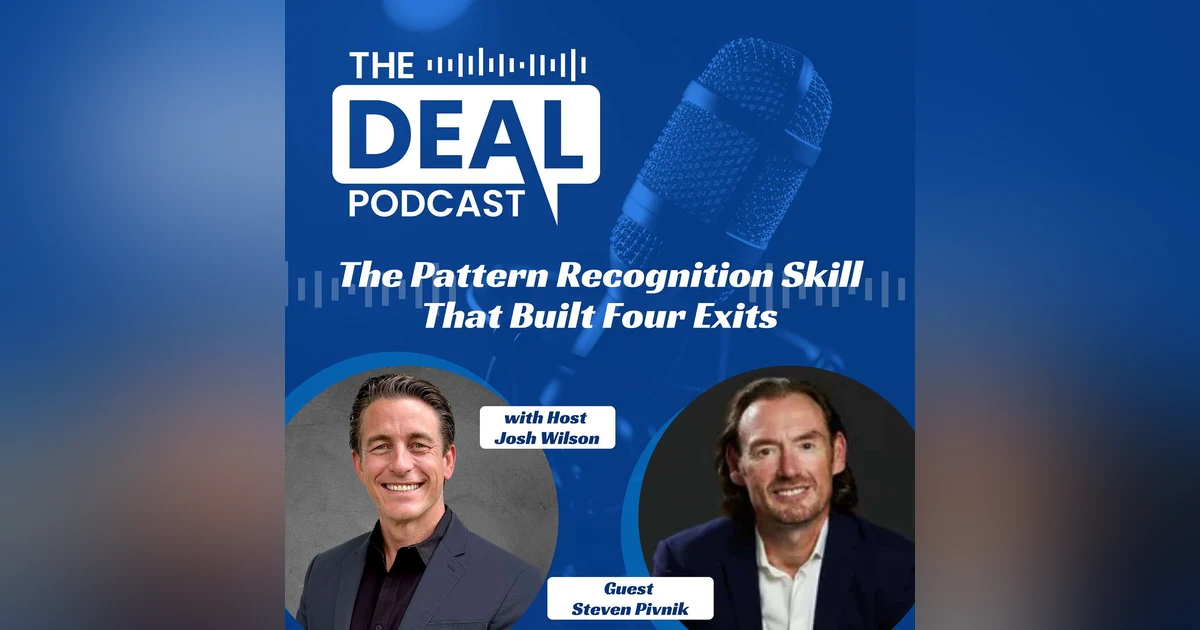
Steven Pivnik on four exits from the same company — licensing software to IBM and Microsoft, surviving fraud and two missed payrolls, the KPI discipline that built the second act, and bringing in a CEO for the $4B sale. Now an exit advisor at Acresis and coach at The CEO Project.
What if the same company could give you four bites of the apple? Steven Pivnik did exactly that — and nearly lost it all in between.
In this episode of The Deal Podcast, host Joshua Wilson sits down with Steven Pivnik, serial founder, endurance athlete, and exit advisor who built and monetized the same software company four separate times before finally selling to a $4 billion competitor. Steven shares the real story behind the wins — and the gut-punch in the middle when he came back from a two-year contract to find fraud, falsified financials, and a company one month from bankruptcy. From immigrating from the former Soviet Union as a toddler to coding Pac-Man on a Commodore 64 to climbing Mount Everest at 55, Steven's story is a masterclass in pattern recognition, founder resilience, and the discipline it takes to actually build something worth selling. Now an executive coach with The CEO Project and exit advisor with Acresis, he helps founders avoid the mistakes that nearly cost him everything.
🎯 What We Cover:
- How Steven licensed the same software to IBM and Microsoft in back-to-back deals
- The "MBA in a box" he got working under a seasoned management team post-acquisition
- Why pattern recognition is the most underrated founder skill
- The fraud and betrayal that nearly killed his company while he was away
- Why he interviewed every employee on day one of his return — and cut from 30 to 8
- How he made good on two missed payrolls over 12 months after coming back
- The KPI discipline that separated his second act from his first
- Bringing in a CEO for the final exit — and how to "love like you've never lost"
- His ideal client profile: 10+ years in business, $10M+ revenue, 90% of net worth tied up
- The transformation founders experience when accountability replaces "we've always done it this way"
🤝 Connect with Steven Pivnik: 🌐 https://www.stevenpivnik.com/ 💼 https://www.linkedin.com/in/stevenpivnik/
🎙️ Built to Finish Podcast: https://stevenpivnik.com/podcast/
📘 Built to Finish (Book): Available on Amazon:https://a.co/d/0g77FiBE
💼 Thinking About a Transaction? FA Mergers helps founders, investors, and business owners navigate the full M&A process — from valuation to close. If you're exploring a sale, acquisition, or capital raise, let's talk. 🔗 https://www.famergers.com/
🎙️ Follow The Deal Podcast: 🌐 https://www.thedealpodcast.com/ 💼 https://www.linkedin.com/in/joshuabrucewilson/ ▶️ https://www.youtube.com/@dealpodcast
DISCLAIMER The Deal Podcast is for informational and educational purposes only. Nothing discussed constitutes investment advice, a solicitation, or a recommendation to buy or sell any security. Always consult a licensed professional before making financial or investment decisions.
00:00 - Four Bites of the Apple: The Setup
01:30 - IBM Licensing Deal and the Pivot to Services
02:30 - Microsoft Comes Knocking — The Second License
04:00 - Acquired and "Taken Out" by a $4B Competitor
05:00 - From Soviet Union to Brighton Beach
06:30 - Coding Pac-Man on a Commodore 64
09:00 - Pattern Recognition as a Founder Superpower
11:00 - The MBA in a Box: Learning KPIs the Hard Way
14:30 - Coming Home to Fraud and Near-Bankruptcy
20:00 - Layoffs, Missed Payrolls, and Making It Right
22:30 - The Final Exit: Bringing in a CEO Done Right
28:00 - Endurance Sports, Everest, and Advisory Work
30:30 - Who Steven Coaches Now and Why
34:00 - Built to Finish: The Book and the Podcast
37:00 - Ecuador Executive Retreat and Closing Thoughts
Joshua Wilson:
Hey, good day everybody. Welcome to The Deal podcast. I am so pumped to, um, talk with you guys today. We're gonna, we're gonna have a conversation with a guy who built and sold a company four times, we'll talk about mini exits- ... and took the, the fourth bite of the apple and, uh, kind of walk through the strategies and his mindset going throughout this process and what he's learned, and now what he's doing with what he learned to help other founders. Steven, welcome to the podcast.
Steven Pivnik:
Hey, Joshua, thank you so much for having me.
Joshua Wilson:
Yeah, man. All right. Four bites of the apple. Explain what the heck does that mean when building a company?
Steven Pivnik:
Yeah, it was interesting. So the first bite came when, um, IBM approached us and wanted to license the software that we were selling to, to them and to customers. And for all intents and purposes, we i- we had a choice. We could either li- s- license our software to them, or they were going to write, write that same exact software and give it away for free to customers. So we were gonna compete with free coming from IBM. So they almost put us into a corner and forced us into a, a huge licensing deal. But for all intents and purposes, I could have just dropped the mic, it would've been a great story. You know, immigrant kid, college dropout, built software, licenses to IBM, end of story. Sure. No. What we decided to do instead was build a professional services team around the implementation of that software because we knew that these projects were going to be complex. So we built a professional services team around, around the software to go do projects around the software that IBM is now giving away for free, which was our, our license. Fast-forward a couple of years, another company approaches us and says, "You know what? We wanna get into the professional services game around the, around this technology." Specifically, it was Lotus Notes. I'm really dating myself. You know, back, back in the, in the'90s, Lotus Notes was really popular. And they said, "You know what? We want to buy your professional services division," which at the time was the majority of our business. And so that was the second bite of the apple. Um, th- so they pur- they purchased that division. I was actually part of the deal, meaning I personally needed to go and work there for sev- s- several years. Um, I mentioned college dropout. This opportunity was great for me personally because that was my MBA in a box. I got to work with a seasoned management team, a team that had just raised $75 million, which was a ton of money at the time, to go build this company, and it was just an incredible experience. When I came back to my company after my contract there ended- We basically said, "You know what?" We read the tea leaves, and the tides were moving from a, from a e- email trending perspective to Microsoft. And we said, you know, we were doing all this great work with IBM and Lotus Notes, let's do the same with Microsoft. And we did. Fast-forward a couple of years, Microsoft comes knocking on the door. And they said, "Hey, we, we're, we're tired of buying your software from, from you. It's too expensive. We need to create this functionality for free and give it to our customers." So been to this rodeo. We said, "Absolutely, you know, let's, let's do a licensing deal," and we did a really big licensing deal which dr- dwarfed the previous one, and same exact story. It, it could've been, you know, end of, end of the, the, the company's, um, story, but we continued to invest in the software because it was a non-exclusive license, which didn't preclude us from continuing to go to market with it. So we doubled down on our R&D, made it better, faster, more scalable, more secure, et cetera, et cetera, et cetera. And this is hysterical. At the end of the day, after a two-year effort, Microsoft dropped their efforts to incorporate our tech, our software into Office 365. So they basically scrapped a project that they paid us millions of dollars for, and we ended up growing the company to over $40 million in sales. And by then, our number one competitor, which was a $4 billion software company, got sick and tired of competing with us, and they took us out.
Joshua Wilson:
When you say, "Took us out," what do you mean there? They bought you or they wiped you out?
Steven Pivnik:
There's, there's different types of acquisitions, as you know, right? Yeah. There's acquisitions that are strate- obviously, this was a strategic acquirer, but, um, they, they basically wanted to kill our, our company and our brand, and they wanted our technology because our technology was better than theirs. So they, they, they took over the company. There was no, you know, no more company. They took our technology, you know, scrapped their products that we competed with. Um, h- took most of our staff in the beginning, but after multiple rounds of layoffs, unfortunately, um, slowly but surely, um, re- reduced, you know, our staff that, that came over. So the company was, for all intents and purposes, out of business.
Joshua Wilson:
Yeah, I understand. Wow, so many things to unpack there, uh, for our audience. Steven, uh, let's start with this. Where, where are you from? You said you're an immigrant. Where are you from?
Steven Pivnik:
So my, I, c- uh, we immigrated to America in 1971 from the former Soviet Union, what is now the Ukraine.
Joshua Wilson:
Okay. Oh, fantastic. So you came over here. How old were you when you came over?
Steven Pivnik:
Two.
Joshua Wilson:
Two years old. All right. Do you ha- do you... What was your first memory, uh- that you could ever recall?
Steven Pivnik:
You know what? I don't know if it's an actual memory or b- I've, I've heard so many stories, so many of the same stories so many times, I don't know if I actually r- rem- I was told I remember the actual plane ride over, which I, I really can't have that memory because I was two years old on that plane ride to JFK. Um, I think my, my very, very first memory was, like, riding my bicycle on Brighton Beach as a toddler, in Brighton Beach, Brooklyn in New York.
Joshua Wilson:
Wow. Cool. All right. So growing up in New York, right, you came over here. Growing up in New York, you really didn't have a, an e- much of an experience of living overseas and, and, you know- No other than that. But you, you grew up in, as a, as an immigrant family, right? Mm-hmm. In, in, in New York in the '70s. Right. What was that like growing up in... Like, what did you wanna become when you grow up? Like, what did you wanna do? What, what things interested you when you were, like, in high school?
Steven Pivnik:
Yeah. Um, I was a computer nerd, which I, I guess, which is why I, I eventually, you know, got into computers. Yeah. I like to s- I like to let people know that my best friend was my Commodore 64. Again, aging myself. It's one of the, the, the f- the first computers that was av- available, and I, I c- I spent nights and weekends programming video games. Not playing video games. Programming. Programming v- programming video games, and I, I basically copied what was popular out there. I didn't have t- enough creativity to create my own, so I'm like,"You know what? Let's see if I can code Space Invaders." Yeah."Let's see if I can, let's see if I can code on Pac-Man." So I coded my own version of those games. So I, I didn't think I was gonna g- get into computers growing up. I really didn't, didn't know what I wanted to be, but, um, I just, I really, really enjoyed computers as a hobby.
Joshua Wilson:
Got it. So, you know, building, building stuff, it was fun, right? And you didn't necessarily wanna play the game, you wanted to build the game.
Steven Pivnik:
Exactly.
Joshua Wilson:
So as you... You know, how did you build that first software that actually brought to market? What was that process like?
Steven Pivnik:
Yeah, it was interesting. So we actually started the company primarily as a professional services organization, first and foremost. Yeah. So, uh, again, going back to Lotus Notes, w- at the time, Lotus Notes was really, really hot. It was as hot as AI is today. It was the first truly scalable, you know, enterprise messaging and collaboration platform, and, um, we built up a pretty good reputation in New York City, which is where we were headquartered, as being Lotus Notes experts. Based on that expertise, JPMorgan hired us to build them a conversion program because they were running Microsoft Mail at the time, and they said, "Hey, you guys know Lotus Notes pretty well. Build us this conversion program to convert all of this data for all of our users over to Lotus Notes so that when we launch Lotus Notes, they have access to their old inbox, their contacts, their folders, all of this data." So we looked at ourselves and said,"You know what? That's a pretty boring project, converting email data." But, you know, being consultants and willing to train, trade time for dollars, uh, we wrote that program. Um, we, um, implemented it for them. It worked great, and there was a lot of demand for the similar solution from other platforms because it was a very, very fractured marketplace. There, there was GroupWise, there was G- there, that wasn't Gmail yet, um, Netscape, Eudora. There, there, there were several different flavors of email at the time, so we built up a whole bunch of different products to convert from all of these disparate email systems into one, and that's when IBM came knocking, said, "You know what? We need this as part of our portfolio so that we c- can continue to build market share."
Joshua Wilson:
So when you're evaluating, you know, now you help other people. On the other side of your four mini exits, five mini exits to the big exit right there, you now help founders look at their company and help them distinguish, are you ready to exit? Are you prepared for that- Right... personal finance, business finance, business structure, lifestyle? Like you, y- as a founder who's done it multiple times within the same company, within the same product, which is fantastic, I love this idea of, you know, multiple bites of the apple, and I think we're seeing that more and more, uh, as private equity gets, uh, more involved in these companies as a strategic partner rather than- Mm-hmm leverage buyouts and just taking things over, looking at it as partnerships, so I'm seeing it more. I'd love your thoughts on this. Sure. But as you were building this- You know, like you created something that was h- in high demand and it was hot. I think a lot of founders struggle with product market fit and finding that hot demand. H- like what, what input do you have there, and like how can you know if you've hit gold?
Steven Pivnik:
Yeah. So, um, I actually had this conversation with somebody else the other day. First of all, you've got to b- be pretty good at pattern recognition, right? So you have to recognize when there's a pattern developing out in the marketplace. In our case, the pattern was who is leading the email market and, you know, who's, who's being disruptive in the email marketplace. At first it was IBM with Lotus Notes, then it was Microsoft with Exchange, and then later it was Office 365 or Microsoft 365, right? And, you know, sprinkle in a little bit of Google and Gmail there. So, A, recognize the p- patterns that are occurring. B, take advantage of those patterns, right? When we s- when we started seeing the shift in the marketplace, we took advantage of those patterns by offering, you know, great solutions to facilitate the change that, that was occurring. So pattern recognition, taking advantage of patterns, and r- if you really want to be a trail pla- blazer, create your own patterns, right? So I can't take any credit for creating patterns, but I take a lot of credit for the first two, recognizing and taking advantage of it.
Joshua Wilson:
Super cool. So you've built your first couple companies, had some, you know, great license deals. You had some employees. You built it. Then you got to work with a seasoned management team, and then you said, like, that was like a, a MBA in a box. Compare yourself to your own experiences from building from scratch, no real world, you know, like experience management w- ex- you know, in your own life versus working as, you know, them and then coming back as a founder. Walk, walk us through like what did you learn that you weren't doing as a unseasoned founder? Does that make sense?
Steven Pivnik:
Yeah, no, totally. Great question. I mean, one, one of the biggest things that I learned was, um, KPIs and numbers and m- and monitoring things very, very closely and very, very granularly. Um, as... So my, my title was vice president of customer implementations at, at that company. Yeah. Um, we ha- we had acquired four more organizations after mine, and they reported into me. So I had a pretty large staff of professional services folks that were, you know, out there doing projects, and oh my God was I getting grilled by the CEO on, you know, um, a- average deal size, utilization rates, um, bench time, et cetera, et cetera. I mean, he would literally... We'd have a meeting every single m- um, morning, I'm sor- every Monday morning, and he would grill me on last week's numbers. And then I participated in meetings with other departments where, you know, they were getting grilled, and they were getting scrutinized, and I'm like, "Wow, we never had, you know, this level of, of reporting and monitoring in my own company." So when I came back, guess what I implemented? A whole bunch of, you know, KPIs, management, and monitoring and, and performance indicators and all of that jazz, and our, our, you know, performance im- in- improved markedly.
Joshua Wilson:
It's amazing what improves when you measure it. Um-
Steven Pivnik:
It's... I mean, the, the old adage is, is so true. It's so overused because it's, it's very, very true.
Joshua Wilson:
Yeah. It's true. Um, now when you, when you saw that, at first, right, you're, you're a guy who's already sold, you know, two deals, maybe some money in the bank, I don't know, but now you're working for someone. Going from founder, CEO, maybe some money in the bank, to being an employee where someone's demanding KPIs and accountability from you, what was going on in your mind there?
Steven Pivnik:
It was interesting. It w- it was definitely different, right? Because, you know, when you're, when you're your own boss, you know, you make all the decisions, but, um, at the end of the day, I was so incredibly grateful that this transaction occurred, and it occurred because of the leadership team that was there. So I had a huge sense of loyalty to actually perform and to do my best to justify their decision for, for buying my company, and th- they, they also made it easy for me, right? So they did give me a... They, they, they were a smart team. They, they know that, that they were acquiring an entrepreneurial mindset, right? Yeah. So they, they gave me, you know, plenty of leeway to do things the way I wanted to do things, a- as long as I delivered, right? I st- I still needed to deliver numbers. I needed to deliver, you know, revenue, utilization rates, and, and, um, le- and m- minimal downtime or, or, or bench time. As long as I delivered on those KPIs, they pretty much let me do what I wanted to do.
Joshua Wilson:
Was there a moment in there where you were like, "F it, man, I'm out," or, like- ... uh, this is, you know, it's a, it's a hit to the ego, the pride?'Cause being, being a founder, making the decisions, calling the shots, to the one being like- drilled on KPIs, man, it's hum- it's a humbling situation, especially when you, when you face to face with someone of excellence and they're demanding it of it, you're like, "I'm not used to this level of accountability or excellence." It- it's, it's very challenging, at least that from my experience.
Steven Pivnik:
Yeah. Unfortunately, I, uh, I, I didn't have an, you know, F-it moment because of them. Yeah. I had an F-it moment, and th- this is a huge lesson learned that I would love to share with other entrepreneurs.
Joshua Wilson:
Please.
Steven Pivnik:
I did a horrible job of ma- Because, because this was an asset sale, there was still a company left, and I, I put a CEO in charge to, to run and manage, um, that company. I did a horrible job of ma- of being a shareholder and manage- managing their performance. And the, as a result, um, there, there was a lot of fraud, um, that, that took place, and I was actually betrayed and lied to repeatedly. So my F-it moment came when the bank called me and said, "Hey, you guys haven't made a..." You pers- you're, you're t- I was still the personal guarantee on the company's line of credit. And when the bank called and said,"Hey, you haven't made an interest payment on your line of credit in the last three months. What's up?" That's when I had the F-it moment. And I, and I, you know, I, I started peeling back the onion and realized all of this, you know, fraud and lying that had taken place. You know, falsified financial statements, and the, the list goes on and on and on. So I, I needed to get out of my contract with the company I was working for, and then, you know, go back and play Superman and save my baby which I did.
Joshua Wilson:
Right. Nice. When it comes to delegation, my experience is when you find someone that you're like,"Oh, phew, finally someone who can take this crap off my plate," like the, the temptation is to be like, "Here you go. Boom." And then, like, step back, and then just, like, trust it works out. You know, like, I want it to work out, but, like, the, the brain power of that transfer of knowledge, transfer of control is so exhausting, and finding a, a person who, who's willing to take it. So, like, when they do, it's so... For me, it was so hard to manage that for quality assurance, for all sorts of stuff. Like-
Steven Pivnik:
Yeah... Joshua Wilson: like, looking some of these red flags, or what could you have done differently? In, in that specific example, I mean, it would have just been an e- easy, um, process of, of demanding, you know, monthly financial statements, keeping my old accounting firm in place to make sure that, um, not, not only did I, I not have my own accounting firm, it was, um, he had his own chief financial officer and his, and his own accounting firm producing these statements, which I, I... And they were, they were all complicit in this fraud, um, that was occurring. Hindsight being 2020, I should have left my accountant in place, demanded, you know, monthly financial statements. I should have got maybe a little bit more granular when I started seeing things go into the yellow and into the red, and I, I, I could have, you know, prevented a, a lot of the, a lot of this, you know, cash drain that, that occurred. Because when, when I came, when I came back, we, we were near bankruptcy. We were literally a month away from filing for bankruptcy. That, that's how much damage was done.
Joshua Wilson:
Yeah. Steven, I, I want to hope for the best in people, and I really love, love people, and I love, like, the world of business. But I've worked with some sharks, right? Who do stuff, um, intentionally, and then I've worked with people who just made mistakes unintentionally, but that had, you know, big costs associated with it. You came back as, you know, from working with an experienced m- management team. Now you have this mindset of, "I got burnt in the past, betrayed. I need to m- you know, monitor financials. I need to check in on that. I have to have my right CPA in place to, you know, protect that." But also this new level of accountability and management. How do you do that without being an overbearing boss? How do you do that to create a good culture? How do you... Like, what was your experience in building all that?
Steven Pivnik:
Yeah, I mean, uh, I love the saying, you know, love like you've never lost before, and I too like to see the good in people. I w- I hoped that this was a, you know, one-off situation, and wh- whatever the intention was, it w- it was, you know, it was personal. It happened. I learned a mega lesson. And, you know, fast-forward many, many, many years, when it came time for the fourth, f- fourth and final exit, I wanted to ensure that I wasn't part of the deal because I'd been running this company for 26 years, and it was just time for me to do something else. Yeah. I actually bro- I... So I brought in a CEO to, to run the company for me, and I loved like I never had lost before. Uh, obviously, there was a sh- there was an, a significant amount of more controls in place, but I got the right person, um, who had the right attitude, the right skill set. He gained the trust and respect of everybody on the team, and he did a phenomenal job for the final three years of the company, growing it to the level that we needed it to be at before the final bite of the apple.
Joshua Wilson:
Yeah. Steven, if you look back in your career, your successes, your failures, some of the hard times that you've went through as a founder, as a l- all throughout, what would you say is, uh, one of the most, like, painful lesson that you've ever learned and, you know, that applies to the world of business?
Steven Pivnik:
Yeah, I mean, I, I guess the, the one I just went over was probably the most painful- Yeah bec- because, I mean, it really, really stunk. When I, I finally... You know, when I got that phone call from the bank, I'm like, "Oh my God, this guy's been lying to me for the, the last, uh, three quarters." And when I found out the true, true extent of the damage and the true balance in our bank account and the payroll that we still needed to meet, and the need for me to have to... I, I've, b- because I'd been gone for two years at the time, I, I needed... I showed up on day one of my returning to my job, I interviewed everybody and had them interview for their job, and we went from 30 people to 8 in twen- in, in 24 hours because there was no way I was gonna make that payroll. There was no money in the bank. So- Wow ... it, it, it was gut-wrenching.
Joshua Wilson:
Okay. I... Man, you love people. You had to interview everybody, and you just knew to keep this thing alive, to keep this mission going, we have to lay off a bunch of people, 22-ish people. Yeah. Walk me through that process and what did you learn there as a leader?
Steven Pivnik:
Um, I, I learned that you, you have to do the right thing by people. Um, this wasn't their fault, right? Um, to to his credit, he, he act- um, not to his credit. I can't believe I actually said credit. Um, one of the many things that, um, he did was miss payroll, and he as- he asked the team twice to take one for the team. Said, "You know what? We're not doing that well. We can't make payroll." And the, for, for... This is how great of a, of a, maybe a, a, a cult leader is the best way to describe it. They said okay. So when I came back and I needed to lay off, uh, these 22, um, 20-plus people, I, I made a commitment to every single one of them that the two payrolls that were missed while I wasn't there, I w- I was going to, uh, make good on. And it took me 12 months, but every single one of them, you know, got paid for those two payrolls that, that, that were missed.
Joshua Wilson:
Man, it, it's such a... When you're working those overtime hours to make good of something that happened in the past and you know as I add this value and as I do this work, I'm not receiving the value, I have to go back and pay, it's a painful lesson that I, I think as founders we'll never forget those things in our life. The hard thing that I've found being an investor and being in the world of- capital markets and investment banking and, and doing all this crap for so long is to love like you've never lost is so hard not to bring your baggage into the next deal, the next opportunity, the next partnership. So, you know, as you were going through now investing in companies and working with these founders, how do you make sure that you have a clean slate so you're not bringing baggage in when you're serving these people, but also the remember the scars because it might help them? How do you
Steven Pivnik:
do that? Yeah, I mean, yeah, I mean, I, I, I go back to the pattern recognition, right? The pattern recognition goes, goes, um, applies to hiring as well. Now when, when I speak with individuals and I speak with executives, it's a lot easier for me now to call BS than it was in the past. Because in, in the past, like you don't, you don't know what you don't know, and you've got a, you know, shiny, um, you know, polished executive that's, you know, tell- that's pitching you and telling you this incredible story. And un- unless you have a ton of experience to fall back on and, you know, pre, um, previous relationships, you really can't compare it to anything. So everything sounds great. Mm-hmm. But when you have all of these scars and like all of these pains and all of these, you know, mo- moments in the past, they, they're incredibly... it's incredibly unfortunate that they occurred, but oh my God, were they valuable building blocks for the future. So it, it makes, it, it makes the process, the, the odds of success with hiring, you know, going forward so much better.
Joshua Wilson:
Talk to me about a moment where the wind shifted from,"I don't know if we're gonna make it," to, "Okay, we're getting traction. We can breathe. We can start hiring again. We can pay off past debt." Like talk to me about a moment when, when that shift happened, and what do you think caused that shift?
Steven Pivnik:
Yeah. Um, that shift happened, so like I mentioned, like we had a very, very strong relationship with IBM, right? Yeah. We, we were y- we were kind of like that pilot fish that swims by the big shark, and like we were feeding off of IBM's momentum and all of their market share gains. And then when we saw the tide shift over to Microsoft, um, we actually felt guilty about it, right? Because we were, we would actually go to IBM trade shows and promote the fact that we can now convert email data to Microsoft from IBM. And, um, IBM finally came to us. We, we, we went to renew our sponsorship because we went to this, um, annual trade show in Orlando called Lotusphere. We went to... And we were like a, like a gold level sponsor there. We got a lot of business from that show. We went to renew for the following year, like we always did, and they wouldn't accept our renewal. Oh. They said... And they, they almost said like, "You know why we're not accepting your renewal." And- I, you know, I, I took that as a badge of honor. Like, yes, you know, IBM is not taking our sponsorship money for this show because of what we're doing with Microsoft. Fast-forward a couple of months, I had a meeting with a bunch of senior execs at, at IBM, and I was super nervous, right? Because I needed to tell them that,"Hey, we're going to town with Microsoft. Sorry, the, the tea leaves are sh- are shifting in the marketplace." And the executive said, "Steven, I can see how uncomfortable you are with this meeting. Every relationship has a beginning, a middle, and an end. If this business relationship is ending, uh, we're not taking it personally. Go do what you have to do." I was
Joshua Wilson:
like, "Wow." Wow. Oh, bro, I know how that feels, man. Yeah. Uh, you, you and I are similar in I'm a loyalist, right? Like, I, I, I really value people and I wanna serve them. And, and when we have a reciprocal relationship, man, I wanna dig into that, and I'd love to create a lifetime relationship with some people. The truth of the matter is, is though in some, in business, there's a start, middle, and sometimes there's an end.
Steven Pivnik:
Right.
Joshua Wilson:
Knowing when, how do you do that? I mean, in that instance, they called it, right?
Steven Pivnik:
Yeah. They, they, they called us out on it. Yeah. And I mean, but that, that was like, that's when the wind shifted. That's, that's when they basically, when our, our number one partner basically gave us permission to go and do something else with, with their arch enemy. I mean, they, they called Microsoft the evil empire. And, and that, that's when we went all out and, you know, revenue started really, really climbing when we, you know, you know, came out and with- without, with just totally clearly we told the marketplace that we are now in Microsoft land, and we're your p- we're your go-to partner to help get you to Microsoft technology.
Joshua Wilson:
Just having this conversation with a guy yesterday. He's an investor, and he, he talks about, like, there's addition, or there's growth through addition, like what should we be doing? But there's also growth through subtraction. It's what should we be pulling back from? And sometimes it's sunsetting an old client. It's, you know, it's, it's-
Steven Pivnik:
Or an old, or, or an old product, which- Or an old product ... uh, which, which some companies... I mean, some companies are emotionally attached. Like, I was emotionally attached to some of our products, which, you know, we ended up sunsetting, and it, it was the right thing to do for the company, but that also was painful.
Joshua Wilson:
Yeah. Oh my gosh, Steven, you're so awesome, man. All right. Talk to us about what you're working on now. You've retired... Not retired. You sold not retired. You're like, "I gotta stay in this game." What, what are you doing and why did you get back in? Why didn't you just, you know, go ride your bike on Brighton Beach in, in, you know, New York?
Steven Pivnik:
Well, I, I, I kinda semi-retired. I, I'm also incredibly passionate about endurance sports. I t- I, I got addicted to endurance sports as my midlife crisis- ... because my immigrant family gave me some incredibly ba- bad genes. I love them to death, but they all had cancer, diabetes, high blood pressure, strokes. You name it, my parents and my grandparents had it, and I knew that, that those bad genes were in here somewhere. So I just chose endurance sports as my vehicle to stay as healthy as possible, so if and when that bad stuff hits, I can fight it.
Joshua Wilson:
Yeah,
Steven Pivnik:
yeah. So I, I, I continue to spend a, a ton of time doing IRONMAN triathlons, climbing mountains, and I'm doing ultramarathons. But those are my hobbies. On the business front, I w- I work with... There was two advisory firms that helped me tremendously when I was growing my business. Um, the first was something called The CEO Project, which is a CEO peer group advisory program. Mm-hmm. I was a member there for eight years, and when I sold my company, I was flattered that the founder asked me to join them, this time as an ex- as an executive coach, and start a group of my own. So I work with The CEO Project, where I mentor a group of CEOs, and, like, we go through the, The CEO Project methodology- Mm-hmm ... which I can get into if you'd like. And the other firm, which was with me for the final three years of my, uh, of the company's, you know, growth and exit, was a firm called Acresis. And after they helped me, again, go through the final, the final phases of growth and exit, they too asked me to come join them and work with other, um, founders to kinda, you know, pay it forward in the entrepreneurial community. So I'm ch- really, really enjoying living vicariously through other founders and helping them grow and sell while avoiding all of the mistakes that I made.
Joshua Wilson:
Yeah. How old are you, Steven?
Steven Pivnik:
I'm 56.
Joshua Wilson:
56. So when's the last time you did some type of endurance or something that had stretched you physically?
Steven Pivnik:
Um, I tried to cl- I, I tried. Yeah. I climbed Mount Everest this time last year, and I've got my 18th IRONMAN coming up in two and a half weeks.
Joshua Wilson:
18th IRONMAN. Where's that gonna be?
Steven Pivnik:
Um, this one is in Jacksonville, Florida.
Joshua Wilson:
Oh, okay. Right around the block from us. I used to live in Jacksonville on the, on the beach. Oh, cool. Yeah, they, they, uh... The open water swim is, uh... This time of the year it's nice and warm, but man, they could get chilly in Jacksonville.
Steven Pivnik:
Yeah. It's, um, it's gonna be an interesting swim because it's against the current in the river, so it's an uphill swim to- Oh
Joshua Wilson:
to s-
Steven Pivnik:
to start the day.
Joshua Wilson:
You swimming in the St. Johns?
Steven Pivnik:
Yes.
Joshua Wilson:
Okay, cool. Awesome, man. Well, I'll cheer you on. Um, Steven, as, as we go through the arc of your, your story, now you're helping founders. Walk us through maybe the one problem, like... Well, ac- actually, before we go there, what's the ideal, like, founder that you wanna work with? Give me an ideal on company size, revenue size, stage of company. Like, the ideal one, so if that person's listening in, they go,"Hey man, I'd love for you to work with me," who is that person?
Steven Pivnik:
Great question. My ideal customer is somebody that's been running their business for 10 plus years. They have n- over 90% of their personal net worth, you know, tied into this illiquid asset called their company. Um, they're doing over $10 million in annual sales, and they're pr- preferably in the IT space, whether it be software, software as a service, professional services around some sort of technology, something IT relate... Doesn't need to be IT related, but that's my personal preference because that's where I can really jump into the weeds.
Joshua Wilson:
Why 10 years, right? So I understand the revenue metrics, I understand, man, they've got all their, you know, assets tied up in the business, understand the revenue, I understand the niche, but why the, why the, uh, vested, you know, timeframe?
Steven Pivnik:
Because, um, they're, they're probably m- much more likely to really want... They, they, they may not be actively trying to figure out how to sell their business, but if after 10 years, that's probably when they're getting the itch and the need, and they- they're getting... If they're reading the tea leaves properly, it's been, it's been 10 years. They've b- they poured a lot of blood, sweat and tears, you know, into the company, and they really wanna see how they can monetize all of that blood, sweat and tears.
Joshua Wilson:
Now, as you're talking to them and they say yes to work with you, what do you think is the number one hurdle they have to jump over to get to a yes with you?
Steven Pivnik:
Um, the number one hurdle is th- they need to understand the value and the fee, uh, for working with somebody like, like me and my group. Um, initial knee-jerk reaction, you know, could be sticker shock, but the value proposition is we, we are worth our fee at, at least, you know, 10X over in the increased valuation that we're gonna get for your c- for your, um, company in, in a two to four-year period. So if they can get over the fee and understand that they're gonna make that back 10X in, in the actual valuation that we're gonna help them, um, achieve, then we're, we're golden.
Joshua Wilson:
Yeah. And then as they look back on that, you know, two to four-year vested period that they have with you, you guys go out and you help them, you know, find a, a, a suitable, you know, investment bank to help them sell. But, like, as you're, as they're looking back and they go, "Steven, out of all the things you've done for us, besides valuation increase," okay, what do you think is that one thing that they would say, "That, I, as a founder, I found that piece most valuable"?
Steven Pivnik:
The, our, our last exit actually said it best. He goes, "You guys were transformational in the way you had made me and my team run the business." Because, uh, most entrepreneurs, they're, they're kind of, you know, shooting at the hip. You know, the company does things the same old way. You, when, when you ask somebody, "Why do you do things these, this way?" You most often hear, um, "Because we've always done it this way." Sure. So the, the, the founder said that the, the way you had folks, you know, look, look at their, their department, their organization, you know, start measuring things, start holding people accountable, start putting the right people in the right seats, was transformational, and that's what really led us to have a successful exit.
Joshua Wilson:
Wow. Cool. Now, you have a podcast too, and this is why you're so good at this, this conversation. Give a shout-out to your podcast.
Steven Pivnik:
Sure. So I, ba- based on the story that I just shared with you in terms of selling my company and my endurance, um, career, so my, my, my, my business goal was to sell my b- my company, obviously, and then my endurance goal was to qualify for and compete in the IRONMAN World Championship. When I accomplished both, which was about 12 months apart, I wrote a book called Built to Finish, where I detail my journey, offering tips and tricks and advice on lessons learned, with the hopes of inspiring readers to really think big and achieve big goals. Um, after that book released and hit number one on Amazon's bestseller list, I launched a podcast by the same name, Built to Finish, where I talk with entrepreneurs and other audacious goal setters to, for them to share their journey and to offer advice to, to the listeners.
Joshua Wilson:
And you have your, uh, book narrated by the voice of IRONMAN, Mr. Mike Reilly.
Steven Pivnik:
Mike Reilly. I was, I was blown away. I was honored that he accepted my invitation to read my book. I mean, who better to read an IRONMAN book than Mi- Mike Reilly?
Joshua Wilson:
Yeah. Why, now why didn't you, uh, narrate it yourself as you
Steven Pivnik:
were doing
Joshua Wilson:
it? You know
Steven Pivnik:
what? You know, I really didn't like the way my voice sounded online.
Joshua Wilson:
Yeah.
Steven Pivnik:
And but this is, this is really interesting. So I did, I, I didn't think I would do a good enough job of reading my book, so that's why. And he had read his own book and maybe I think one other book, so I asked him. When we went into the studio, I, I had the idea of, uh, personally recording the, um, introduction and the afterword, and I recorded it in a professional studio. And when I heard it back, I'm like, "Oh my God, I sound totally fine. Why the hell didn't I record the entire thing?"
Joshua Wilson:
It's amazing what a studio will make you sound like when you're sitting in a proper studio.
Steven Pivnik:
Which is why every single podcaster will ask the guest to have a wired microphone, because a wired mic makes all the difference in the world.
Joshua Wilson:
Oh my gosh. Do you know how many times, like I... I've interviewed about 2,300 people, and I'll be like, "Okay, do you have a wired mic? Do you have a good internet connection? Do you have, you know, good, good..." "Oh, yeah, yeah, yeah." And then they'll show up in their car with AirPods on Like, oh my God. Doesn't- It happens all the time. Anyway, Steven, you're absolutely fantastic. It was great connecting with you. Ladies and gentlemen, what I'd like, love for you to do is go check out his podcast, Built to Finish podcast. Give him a listen. Give him a raving review. Uh, his contact information will be in the show notes below. Always reach out to our guests and say thank you for sharing your time, energy, effort, and wisdom in, with, with us as a community. If you'd like to figure out how to work with him, just ask. His contact information will be in the, the show notes. And then let me finish with this, Steven. Is there one question that I should have asked you that I screwed up and did not ask during this interview? Uh,
Steven Pivnik:
um, you should have asked me, do you have any exciting events planned?
Joshua Wilson:
Go for it.
Steven Pivnik:
So I'm actually hosting an executive retreat in Ecuador, where anybody that's interested in learning, it's a, it's an entry-level mountaineering course, so no prior mountaineering experience required. So we're gonna be climbing one of the 19,000-foot volcanoes in Ecuador, and that, that retreat is going to be bookended with exit advis- advisory services, um, before the trip and after the trip, with a whole bunch of, you know, meaningful conversations with like-minded individuals during the trip.
Joshua Wilson:
Fantastic. And when is that?
Steven Pivnik:
That's, uh, August 3rd of this year.
Joshua Wilson:
Cool. All right. So make sure you send me that information. We'll put that in the show notes below, too. Hopefully, you guys are listening well before August, so you can- ... you know, dive into and maybe join him climbing a volcano. That sounds pretty cool. Uh, like I said before, fellow deal makers, reach out to our guest. And if you have a deal that you'd like to talk about here on the show or have our group take a look at it, maybe even help you sell that middle market company, head over to thedealpodcast.com, fill out a quick form, and let's get the conversation started. Till then, see you on the next one.
Steven Pivnik:
Thanks, Joshua.