


Mergers and Acquisitions in the Nonprofit World
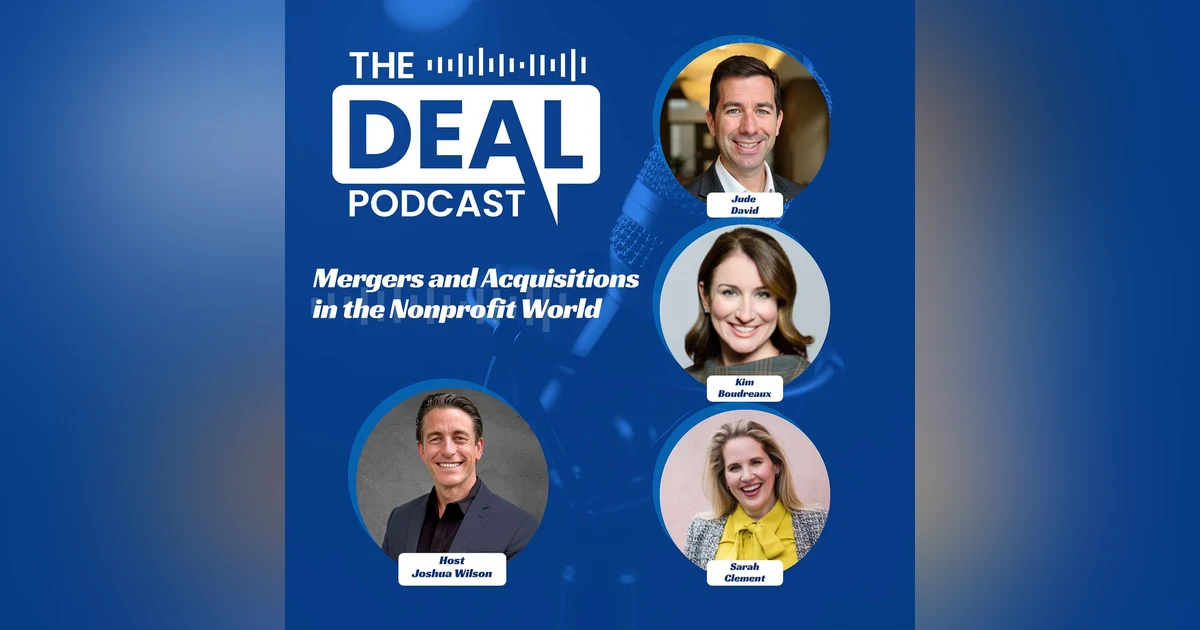
What if the smartest growth strategy in your community wasn't being run by a private equity firm — it was being run by a charity? Kim Boudreaux and Sarah Clement of Catholic Charities of Acadiana have spent the last two decades quietly executing one of the most disciplined nonprofit roll-up strategies in Louisiana — growing from a $1.2M agency with 23 employees into a $15M, 90-person, 14-organization platform serving eight civil parishes. In this episode, host Joshua Wilson and co-host Jude D...


What if the smartest growth strategy in your community wasn't being run by a private equity firm — it was being run by a charity?
Kim Boudreaux and Sarah Clement of Catholic Charities of Acadiana have spent the last two decades quietly executing one of the most disciplined nonprofit roll-up strategies in Louisiana — growing from a $1.2M agency with 23 employees into a $15M, 90-person, 14-organization platform serving eight civil parishes.
In this episode, host Joshua Wilson and co-host Jude David, JD, DCL, MBA and Managing Partner at FA Mergers, sit down with Kim Boudreaux, Chief Executive Officer, and Sarah Clement, Chief Administrative Officer and 2023 recipient of the Catholic Charities USA National Management Excellence Award, for a candid look at how mission-driven organizations apply real M&A principles — economy of scale, sub-10% administrative rates, EOS implementation, and rigorous due diligence — to expand impact rather than profit. They open up about merging six nonprofits in a single day, navigating boards, integrating cultures, and the hard call to raise minimum wage to $15 an hour before it was cool.
🎯 What We Cover:
- The bishop's challenge that launched a 20-year roll-up strategy
- Why economy of scale matters more in nonprofits than most people think
- The day they closed six mergers — and what they would do differently now
- How to approach a nonprofit board about a merger without bruising egos
- Using EOS (Entrepreneurial Operating System) to scale a faith-based enterprise
- How they grew FoodNet 110% and Rebuilding Together Acadiana 290% post-acquisition
- The succession-planning angle that opens nonprofit M&A conversations
- Hiring people smarter than you — and the test Kim used to vet Sarah
- Building a culture of mutual accountability, honest feedback, and "start/stop" exercises
- Why the $15 minimum wage decision changed how the whole organization operates
🤝 Connect with Kim Boudreaux:
🌐 https://catholiccharitiesacadiana.org/
💼 https://www.linkedin.com/in/kimberly-boudreaux-186094175/
🤝 Connect with Sarah Clement:
🌐 https://catholiccharitiesacadiana.org/
💼 https://www.linkedin.com/in/sarah-clement-562b7913/
🤝 Connect with Co-Host Jude David, JD, DCL, MBA:
💼 https://www.linkedin.com/in/jude-david-jd-dcl-mba-172a6a76/
💼 Thinking About a Transaction? FA Mergers helps founders, investors, and business owners navigate the full M&A process — from valuation to close. If you're exploring a sale, acquisition, or capital raise, let's talk. 🔗 https://www.famergers.com/
🎙️ Follow The Deal Podcast:
🌐 https://www.thedealpodcast.com/
💼 https://www.linkedin.com/in/joshuabrucewilson/
▶️ https://www.youtube.com/@dealpodcast
DISCLAIMER The Deal Podcast is for informational and educational purposes only. Nothing discussed constitutes investment advice, a solicitation, or a recommendation to buy or sell any security. Always consult a licensed professional before making financial or investment decisions.
00:00 - Welcome and the Business of Charity
01:22 - Meet Kim Boudreaux and Sarah Clement
02:34 - The Bishop's Challenge That Started It All
05:19 - Three Pillars: Hunger, Home Repair, Resources
06:41 - Why M&A Made Sense for a Nonprofit
10:55 - EBITDA Doesn't Apply — So What Does?
14:40 - Six Mergers in One Day
18:00 - Approaching Boards Without Bruising Egos
24:54 - Overcoming Pride and Hardness of Heart
29:50 - Hiring People Smarter Than You
35:09 - Firing With Love in a Mission-Driven Org
41:09 - Building a Culture of Mutual Accountability
50:48 - What God Taught Them About Service
58:18 - How to Get Involved
Joshua Wilson:
Good to everybody. Welcome to the Deal Podcast. Uh, we're running a series right now, if you haven't noticed, and where we've been talking a lot about the deal of charity, the deal of salvation, the deals of helping people who are less fortunate. And, you know, this has been a, a series that we. That we were reactive to your requests. You dug into a few stories of people who bought, built, sold, you know, million dollar businesses, a hundred million dollar businesses. And, and heck, we love doing that. You know, we sell businesses, that's what we do. But we had a lot of people going, you know, from transitioning from the business world they sold. And they, they go, I wanna now live a life of impact, or I want to give to impact. So to answer your request on the, the business of nonprofits, the business of salvation, the business of these things that you just might not wake up every day and learn about it in business, school or in life. We went, we set out on a mission to do this. So this podcast set, you know, powered by FA Mergers and our job and our mission is to, through this podcast, is to inspire you, but also help share some stories of other types of deal makers that you might not have ever thought about that. So, uh, we have a, a charity on today. That, uh, Jude's gonna kick us off and introduce
Jude David:
Jude. Well, thank you, Josh. Uh, we've got Kim and Sarah here today from Catholic Charities. Oh, Catana. Um, you know, for people who don't know what that is, um, it's, you know, serving, um, the needy part of our population, uh, in whatever way that might be. You know, they, they serve folks who don't have a meal or a place to lay their head at night. Uh, people who need to get cleaned up and need help getting back on their feet, but also home bound people and, uh, other folks that just need a hand in our community. Um, and really, you know, it, it's an extraordinarily big business. To do that kind of charity work in a city the size of Lafayette. And so we're so honored to have you guys on. Thanks for joining us today.
Kim Boudreaux:
Thanks for having us. Thanks for having us.
Joshua Wilson:
Yeah. So you guys might hear a few different voices. No, actually, you definitely will hear a few different voices. I'm Josh Jude's co-host Brandon, behind the operation. Sitting in front of me, we have Kim, and then to my right of her is, uh, Sarah Kim. Uh, welcome to the podcast show. Let's start with you.
Kim Boudreaux:
Thanks for having us today.
Joshua Wilson:
Yeah, you got it. Why don't you tell us a little bit about who you are and, uh, what do you do?
Kim Boudreaux:
Okay. Uh, so I serve as the CEO of Catholic Charities of Acadiana. I've been in this role now for 20 years. Um, I've been with the organization for 25 years. It's. Um, sometimes I feel that, and sometimes it, it seems like it happened quickly, but it's been a joy and an honor and just a, a gift to spend these years of my life in service in particular to the church. Um, so the work of Catholic Charities is really the humanitarian office of the Catholic Bishop, and, uh, each diocese across the country, um, has a Catholic Charities that is attached to its bishop and really, um, he's my, he's my boss. And, um, each diocese can have a variety of different ministries, uh, according to the local needs of that community. Um, when this bishop came in, in 2005, uh, he spent a day with me and at the end of that day, um, he looked at me and said, is this all we're doing? Um. And I was both insulted and excited in the same, uh, moment because, uh, the work that we had been doing was monumental. Um, however, we were an annual, uh, budget, about 1.2 million. We had about 20, 23 employees. Uh, most of our work was focused in the city of Lafayette. And, um, and particularly it was focused on homeless services, a soup kitchen, a homeless shelter. Um, and he said, look, our diocese covers eight civil parishes and we're bigger than just Lafayette. And the needs of the people in this diocese stretch more than just in homelessness. And the work you're doing is important, but we need to do more. We need to engage every Catholic and every person of goodwill and works of, of charity and of mercy. Um. So my first question was, are you gonna give us money? And I'd be happy to do it with resources. Um, and he really challenged us to, um, to call the community to service and to support. Um, so that day, uh, spent a discernment period of how do we grow to cover eight civil parishes and to begin work in other, uh, fields of, of charity and what does this look like? And so we. Took the next two years to meet with, uh, priests across the diocese that were, um, in these rural parts of our community, and had conversations with them on, uh, what needs did they see of their people, what kind of suffering were they experiencing? What services did they feel like they needed help with? And after the two years were finished, it was really bucketed into three areas. Uh, the first one was they all felt compelled to help feed the hungry of their, uh, of their community. The second area of focus that was pretty consistent was many of them were visiting the home bound in their community and either bringing them food or visiting them or bringing them, uh, the sacraments and their homes were in deplorable condition and they felt like they needed to help them fix their homes. And the third thing was they felt like they needed money. And so we felt like those were three areas that we needed to take seriously. And um, and we decided to take action through acquisitions and mergers because there were existing nonprofits in our community that were doing that work. They were doing it well. They had great reputational brand. Um, and the community loved the work that they were doing. And we saw an opportunity for the economy of scale, of merging with other nonprofits. Um. You know, when we look at our administrative rate, it's below 10%. The Better Business Bureau recommends that a nonprofit operates with less than 33%. And so the smaller your organization is, the higher the administrative burden can be, which means less of the dollars that are coming to that nonprofit go to the actual services of that nonprofit. And so trying to keep a tight administrative rate really does translate to more services being able to be provided. And so that was the last, um, real, really 10 years have been a journey of growth through the strategy of acquisitions and mergers. And today, uh, we now operate nearly 14 organizations underneath the umbrella of Catholic Charities of Acadiana. Our operating budget is about. 15 million a year. Um, we're right at, I believe, 90 employees and we cover all eight civil parishes of our, of our diocese. And so it's been, um, a beautiful journey. I'm grateful for the leadership and the vision of the bishop that I work for today. Um, so anyway, it's a little bit about just at a very high level. Um, obviously a lot of detail in that, but at a high level, that's what we're doing. Um, yeah.
Jude David:
Yeah. 90 people on the payroll, that's a, a pretty large business. Um, how many volunteers do you think you guys have at a given year?
Kim Boudreaux:
So we probably average 60 volunteers a day.
Jude David:
Mm-hmm.
Kim Boudreaux:
Is the minimum that we need to, uh, operate. Uh, and, and obviously in that we have many more, um, based on different, um, events that we will have. Mm-hmm. Um, so it, it's a significant number. Sometimes we have people that are volunteering every day, uh, the same person every day. Sometimes it's, you know, people come once, you know, month, once a year. That's really, we see that our work is not only to care for the poor and those that suffer the vulnerable of our community, but to bring others along with us. And we see it as a dual mission, um, as our bishop has asked us to, to call all people of goodwill to service. Um, that it's just as much a part of our mission, um, to bring people into service as it is to actually care for the poor. I don't, I know that Sarah. Oh,
Sarah Clement:
no, I was gonna say, I could pull up our Power BI dashboard and tell you exactly how many, um, you know, unduplicated, you know, shifts, et cetera. But we average probably, you know, just under a hundred thousand hours a year of volunteer service. Um, and anywhere between, you know, 10 to 15,000 people, um, cycle through our programs throughout the year. Um, and I, I would agree with Kim, we have really pivoted over the last five years to really make investment in creating opportunities for people to, um, have an impact in the community. And so we are just as often thinking about what services people need as ways for people to interact, um, and have an encounter, um, with Christ, um, and with those that have needs and, and really break down the barrier between, uh, this mentality of like us versus them, uh, or us and them, and it really just being us.
Joshua Wilson:
I, I love this conversation and I'm so glad Jude's in for this because Jude has a, a way of talking about EBITDA and um, and scale of an organization, systems, process, efficiencies. Before we get into the mergers and acquisitions and efficiency rates of, you know, administrative, uh, Jude, you know, when, when you're looking at a business to acquire, you're looking at a few things and, and the way you measure a business when you're buying it is EBITDA and a and a few other metrics. The ability to scale, the ability. These things kind of like, just give us a, maybe a brief overview of that, and then partly into the, the world of ask them a question about, you know, mergers and acquisitions within non-profits. So, I'm, I'm teeing you up, buddy. Go for it.
Jude David:
Yeah, I mean, in, in the for-profit world, 90 plus percent of acquisitions are valued based on a multiple of ebitda. Um, really because it's, it's the best way to compare one company to the next. Mm-hmm. In terms of what they're accomplishing, what they're achieving. Really different than the nonprofit world. Um, be very curious to hear how you guys have focused your m and a energy. Like how do we acquire a new skillset, a new group of people we're serving?
Sarah Clement:
Mm-hmm.
Jude David:
Um, how do we figure out whether that makes sense in our budget? How do we make sense if this is a, a part of our skillset?
Sarah Clement:
Mm-hmm. I think there's actually two parts to that conversation. It's not just what have we merged or acquired, but also existing programs in the evaluation of what we do ongoing every year, every quarter on what we're currently doing at what makes sense. Kim spoke a little bit about why we, or the areas that were identified across the diocese. Um, and how fulfilling that meant us looking at either standing up these services on our own or who was already doing that well within the community. Um, and so we were able to identify specific nonprofits here. And part of that evaluation is, you know, looking at the p and l, looking at, you know, the last five years of, of, um, you know, their financials, looking at what, you know, physical assets they have, um, you know, maybe intangible assets such as reputation and, and things like that. And, and projecting out what do we think that would look like based off of our processes, based off of the systems that we have. And what we were kind of seeing with two of the nonprofits that we merged with were, um, you know, the executive director was everything. It was the development director, the bookkeeper, the CEO, the spokesperson. And bringing those people into our, um, umbrella allowed them to really focus on why they. Started this work in the first place, which was to serve people. And we have a super high functioning, um, and I mean I'm biased, but, um, administrative and external affairs department. And we have spent a lot of time since probably 2015 working through an operational system called EOS, the Entrepreneurial Operating System. And so it gave us this lens to always be thinking about growth and then evaluating, you know, what are we looking at revenue, what are we looking at, you know, volunteers, number of people served, and what does that look like if we copy and paste it into our existing structure? Um, so I had written a couple of the things down before we left, but one of those nonprofits was food net, which has seen 110% growth. In terms of revenue and people served since we took over that program in 2019 and rebuilding Together. Acadiana is another program and they're at about 290% growth, um, over the last five years, which those are really exciting things to see because in a lot of ways I think we didn't know what we were doing when we did that in 20, 20 19. And to be able to kind of look back and say, oh, we did the best that we could. Now we feel way better prepared to do it again in the future in terms of evaluation, implementation, and moving that forward. But to kind of take a look backwards and say, oh, that, that thought we had, uh, that was loosely evaluated and now more formally evaluated was the right move.
Jude David:
M and a can be hard even in the for-profit world where you have a lot of resources and ability to work on integration. Um, it could be hard. You, you take cultures of different organizations that operate differently, that have a different mission. And you mash 'em together and say, now we're one. Uh, you know, tell us about how that's gone for you guys as you've done these acquisitions. You know, what have, what have been the great things, what have been the challenges trying to integrate multiple companies together, multiple nonprofits together?
Sarah Clement:
Well, we did what, five at, at one time? Six. Six in
Kim Boudreaux:
one day.
Sarah Clement:
In one day.
Kim Boudreaux:
And so I would say, would say that's advised. Yeah.
Sarah Clement:
Yeah. I would not recommend that now. Right,
Kim Boudreaux:
right. I think that that was, we didn't know what we didn't know. And, um, we didn't have chat GPT back then. And so, um, we merged all six groups on one day and
Sarah Clement:
we doubled our entire agency size. Cross fix, cross fiscal years.
Kim Boudreaux:
Yep.
Sarah Clement:
We closed the books on the 30th one way and opened them the next day. Totally different.
Kim Boudreaux:
And so for the first few years. You know, we questioned, did we do the right thing? Did we make the right decision? What have we done? Um, because of that, because of the, um, there's a transition period of, um, number one evaluation of, uh, although we had done a lot of due diligence in our, uh, pre-merger work, um, we needed a lot of office space and we didn't have the space for them. And I wasn't ready to invest in a capital, um, infrastructure until we spent time, um, either growing or, you know, solidifying our operations. Um, because we didn't know what we needed. And so there was this period of time of, um, we're in a temporary space. Um, getting operations, uh, transitioning, uh, staff to be right sized and mm-hmm. Um, and so that was,
Sarah Clement:
tech systems were a big one. You know, our process of the way we do things, um, we have a high level of, of accountability within the organization and mutual accountability among staff. And, um, you know, there was a big turnover in a lot of staff when we, you know, on the backside of that, partially because we were implementing EOS at the same time. And, uh, you know, that is a, a very high, you know, right person, right seat. You know, mentality when you're first implementing that. But I will say, you know, getting those processes, particularly as it relates to our tech, our data collection, our compliance, uh, was probably the biggest lift. And then culturally, I think, you know, we have leaned into EOSA lot to create that cadence of weekly, quarterly, and annual meetings with, you know, not just leadership staff, but everyone else to try to really share the vision from the top, um, so that everybody can feel a part of the vision, um, and understand why we're doing things. But it has, I would say, honest, if I'm being very honest, I would say the last couple of years has we've really been able to solidify the culture and the Catholic identity across all of those merged departments and programs. Mm-hmm.
Joshua Wilson:
Six mergers in one day. Jude, how many have you done in one day?
Kim Boudreaux:
Not sick.
Joshua Wilson:
He was an m and a attorney and he's bought and sold a lot of companies. So you guys,
Kim Boudreaux:
you know, better
Sarah Clement:
ignorance is bliss. Guys, we did not know. And I will say, you know, most of those, those acquisitions or mergers, however you wanna define it, we, we took about a year to get to the point of really signing on the dotted line. And so there was a lot of conversation. We tried to get through a lot of the minutia so that we didn't have these issues, but Right. Because we had never done it before. Uh, we didn't know what we didn't know. Now we know so well,
Kim Boudreaux:
and now
Sarah Clement:
the next one will be very different
Kim Boudreaux:
and a lot of negotiations with the, between the boards.
Sarah Clement:
Mm-hmm.
Kim Boudreaux:
Um, and I think that. Each one was different. Some of them were gonna have a surviving director that transitioned over some, which we felt were good opportunities was when these organizations were between mm-hmm. Leadership and the board was looking for the new director. Um, we saw that as an opportunity, um, to approach the board and say, Hey, before you hire someone, would you consider this conversation? And that has continued to be, um, kind of a tactic that we've used in nonprofits that we have interest in, uh, because we have a desire to continue to grow is in between leadership. Um. Yeah,
Joshua Wilson:
I, I, I wanna dive in here because I think, you know, for, for the people in the world who have experience with mergers and acquisitions, they're going, okay, all right, let, let, let's walk through this. You, you, you shared a value proposition in their succession plan. They're between leaders. Mm-hmm. Right? And then you guys say, we have a, a holding company, essentially. Mm-hmm. We have our, our group that if you roll this in, the mission could go for a lot longer rather than die as a board member, you're like, oh, that completely makes sense. And it could, you know, roll into a group that has, you know, systems and processes and this mission might not just continue, but it might grow.
Kim Boudreaux:
Right.
Joshua Wilson:
That makes sense to me. Now, here's what doesn't make sense to me. And I'd love, like, we go out on a mission, we go a buy side mandate, right? I don't know if that happens in the nonprofit world, but we go look for organizations that. You know, it could fit the mission that maybe we have a gap.
Jude David:
Mm-hmm.
Joshua Wilson:
Right? So we go out and we knock on a nonprofit store and we go, Hey, we would like to buy your company. We would like to do a merger snack. You know, how in the world does that conversation get started for an executive director who founded that, who's running it, and now you're saying that you want them to. Hand it over or join you guys. That baffles my brain. Like, walk me through that.
Kim Boudreaux:
It's sensitive, right? Yeah. Um, and I would imagine that it's the same in the for-profit world, that there's a lot of, uh, pride in the work that's been done, um, because good things have happened and for some organizations it's the legacy, um, of the founder that the organization is carrying forward. Um, and so I think always we've approached the nonprofits that we've, um, been interested in from a place of profound respect for the work that's been done, um, in an interest to take what has been done and to, um, accelerate it, to expand it, and to enrich it and to honor the legacy, uh, of the people that began that work by, um, serving more people than they could on their own. And so. We've tried to approach these conversations with deep respect. It's an emotional thing. It really is an emotional thing. Um, not all of our conversations have ended in, uh, mergers. And, you know, a lot of these conversations are a, it has to be a good fit for us and it has to be a good fit for you. And just by us entering into due diligence doesn't mean it's gonna end with us getting married. This due diligence serves as a purs purpose of, you know, uh, discernment on both sides of whether this is a good fit for both of us. And so there have been, um, conversations and periods of due diligence where at the end of it we've decided, hey, look, like for one reason or another, this doesn't work. We have had mergers where some of the board has have left and said, I don't support this, I don't agree with it, and we're resigning from the board. Um, and, and so they're, each one has been different. Um. But going back to how does, how do you approach those conversations? It's with, we believe in what you do and we want to work with you in doing it. Um, and we wanna create a succession plan for this through, um, Catholic Charities. And we think that we have a great, um, opportunity for growth because we have a hundred and thirty, two hundred thirty five church parishes in our diocese. Um, a few hundred Catholic parishioners in our diocese. We've got what I mean, wait it 200,000, 300,000? Yeah,
Sarah Clement:
it's like 300,000. Yeah.
Kim Boudreaux:
Catholics, we've got 32 schools. And so, and we're a deeply Catholic community. And so when we look at our, how we scale, um, you know, with our food bank, it was like, okay, month one I want a one food drive. And every, you know, I want a food drive and a school food drive, and a church and a food drive and a business like every month. And the next year I wanna. Two food drives in a school, two food drives in a, uh, church, and two in a business. Like, and it was, um, we had the infrastructure to scale and dramatically reduce, um, the cost of food. Uh, dramatically increase the amount of food we were bringing in. Um, dramatically increase the volunteers that served, uh, the geographic territory that we're working in. Um, and so just through our, the infrastructure of the Catholic church, I mean, it, it has an accelerator on it that, um, that can scale rapidly. And so it was kind of the, if you care about feeding people, uh, we care about feeding people, um,
Sarah Clement:
we can help you do it.
Kim Boudreaux:
So
Sarah Clement:
yeah.
Kim Boudreaux:
I don't know if you have
Sarah Clement:
No, I think that sums it up. I think, um. We have had tense conversations for sure. Over the years. We're not finished. We, we are always evaluating and we have like a little short list of, you know, if the timing were right, we'd probably make an offer and here's why. Um, we've, we send out, you know, letters of letters of intent or interest, you know, I mean, we, we do a lot of the same things that a for-profit, uh, for-profit industry might do. It just, I think the conversations look, you know, a
Jude David:
little different, but I wish more nonprofits were open to that kind of conversation. Mm-hmm. Uh, I feel like there's a lot of pride and ego wrapped up in the nonprofit world, and that's probably why more people don't approach it, or at least not until they have to. Mm-hmm. Like whenever they have a crisis, crisis transition and leadership and they need, uh, some kind of exit. One of our Deal podcast alum, uh, Missy Andrati, um, seems to have a mission of, of doing this, you know, connecting nonprofits and, you know, trying to. Get them to think about, well, are we doing the same things? Is there a way we can do it together? Mm-hmm. Do we need all this administrative burden? Mm-hmm. You know what, if we're operating at 50% overhead mm-hmm. Rather than that 33% or less. Mm-hmm. Uh, you know, is there a way we can do it better? And I wish more nonprofits approach that conversation. I mean, when you reach resistance, um, you know, people thinking, but my ego, my pride, my mm-hmm. Organization I founded this, you know, what's, what's the best way to overcome that challenge or soften those hearts a little bit?
Sarah Clement:
I was gonna start with Reating, what you already said, because I do think that is a great place to start. The other place that we've, we've gone, and I do think it appeals to certain audiences, and I think we try to tailor our presentation, our ask based off of who we're talking to, but is to look at data really, and to say, Hey, we are actually already doing this. You're also doing it. If we did it together, this is what it would look like. Pushback that we get most often is, and I think a lot of it is fear-based, but it is also valid. You know, I don't wanna lose my organization's identity. I don't wanna lose what's special about it when this merger acquisition happens. Um, and, and right now, the way that we're set up legally, you know, they would really just become a part of Catholic Charities. And so there is an issue with, okay, how do we retain that identity for you? Is it beneficial to retain that identity? But I would say we've appealed mostly to, um, how do we, how do we continue this for you, but also what does the data say locally about what work? We're duplicating, and if we all really do care about the work itself, this makes sense. Um, and it's, it's not always met positively.
Kim Boudreaux:
We, we do have, we do recognize that we do have big personalities and, um, and so we try to, you know, take ourselves down a notch sometimes, uh, when we have these conversations. And, but we really believe in economy of scale. We really believe in efficiency. We really believe that there's so much poverty and so much suffering in our community that we have to be smart about it. And there is not enough charitable dollars in our community to support every single, um, good intention. And so I think good intentions need to be met with best bus business practices. And so the, so that the important work of caring for the poor and those that suffer in our community can be done well. Um, so that's, we believe strongly in it. And, um, and so we sometimes have to kind of take ourselves down a notch so that we're not, um, you know,
Sarah Clement:
overly aggressive.
Jude David:
Yeah,
Sarah Clement:
we, we do talk a lot and I, you know, I don't know where this comes from inside of me, but I'm a, I'm a big believer in, because we are Catholic, because we have been given this charge because of our faith, um, and because of what's behind it, the only response is our excellence and, and excellence as a business, excellence as an employer, excellence in our service and compliance, et cetera. The bare minimum is not enough. Um, and so we talk a lot about that, which I don't know if that always comes across well when we speak, but, um. You know, that is something that we've built our own organization on and something that we, we want to see everywhere. Um, and so I think that also just kind of drives our desire to bring the parties together, you know, to be excellent for the people that need us.
Jude David:
I can tell you guys are so open, like you wanna listen to the data. What does the data tell us? We're mission driven, we wanna focus on the mission and how do we accomplish the mission the best? And I wish everybody in the nonprofit world approached it that way. Um, you know, there's a lot of, when, whenever you run against that pride where it's like, but I don't want to listen to the data because of me, you know, because of whatever I want, or whatever it is. You know, there's a, um, Oscar Wilde said, uh, consistency is the last bastion of the unimaginative.
Joshua Wilson:
Mm-hmm.
Jude David:
And, you know, I think that applies both in the nonprofit world and in a lot of other business.
Sarah Clement:
Mm-hmm.
Jude David:
If people see data and they push back because it, it doesn't align with what they want to see in their business. It just means that, you know, they aren't open. They aren't right. They've got that hardness of heart, and I'm totally closed off to what the world tells me about it. But we see that in the for-profit world constantly, and that's those businesses that cap out at a certain level. Mm-hmm. And they can never get past the owner. Mm-hmm. Because they aren't willing to bring people in. How did you guys do that? How did you, you know, focus, you know, whenever the bishop challenged you and said, is this all we're doing? Like, how did you make that transition and say, okay. I'm not gonna let Catholic Charities be limited by me and my resources and my capabilities. I want to bring in a coalition. I want to have those 90 employees and those 15 different businesses under that umbrella.
Sarah Clement:
I have a story.
Jude David:
Okay.
Sarah Clement:
So, um, I'm gonna take the beginning of this one'cause I think it's a good story. Um, and a lot of it has to do with EOS. So we had onboarded EOS in 2017. We had a huge amount of turnover, big organizational structure shift, you know, getting the structure right, getting the people right. And I found myself, so I started out at, at the diner, right? So I was the director of the diner. I started people food, I ran a kitchen and we opened a hygiene center. I ran the hygiene center. I did not, I, I did not come with a client background. Then I was the development director. Then we have this big EOS restructure and Kim says, I want you to do this, so you gotta replace yourself. And I remember her coming to me and saying, you gotta hire this specific person, Ben Broussard, who everybody really, you know, everybody knows here. And he was working in oil and gas at the time. And I thought to myself, there is just no way that this deal is gonna go down. She's like, you're gonna hire him. I'm telling you he's the next right person to run this part. And if we're going to get where we need to go this, like we gotta do it. And that mentality of if you know you've, you've got the right person, the right skillset, even if that's not what you look like today, if you evaluate it. And we did. I mean, I look at who we are today as Catholic Charities and I think about the people that we hired in that period, right? Mm-hmm. Before that exponential growth. And there's no way we would've gotten where we are today without taking a risk and hiring people that were maybe, um. It's a little bit bigger than where our organization was. I don't know a better way to say that, but we've took, we've taken a lot of risks. Other risks we've taken are, um, you know, with staff in particular are making sure that we're, you know, doing market evaluations on compensation, which we've done a couple of times. We took a big risk and bumped everybody up to a $15 minimum wage before that was cool, you know? Um, and for a nonprofit to do that sometimes without knowing for sure where the revenue is. Um, but I know it was scary for me when we did it, but I look at the staff we have now and the staff we continue to have, we wouldn't be able to do what we do and grow the way we grow without it. Um, I'm always thinking about who's smarter than me. Mm-hmm. Who's smarter than me that I can bring in. Um, and I, we've made some hires this year that I'm, that I supervise now, and I'm going, they are all way smarter than me, and I'm terrified and excited about the growth that's gonna happen in their departments. Um, and so we're, we're a little bit like building, you know, we build admin so that it can write the grants and manage the growth of the departments, and then we grow the departments and then we realize, oh gosh, admin has to grow again a little bit. You know? And so we're always sort of evaluating a push pull of strategic growth. And a lot of it has to do with the staff we bring on board.
Jude David:
I mean, hiring the right people is everything.
Sarah Clement:
Mm-hmm.
Jude David:
Uh, if you hire the wrong people, you'll never get out of a hole. Um. And when I talk to business owners who tell me that people don't work the way they used to or you can't find the right people, you know, it's the same folks that I talk to. And I say, well, you know, what's your average employee making? And it's like, well, $11 an hour. It's like, well, yeah, you can't find the right people at $11 an hour. Mm-hmm. Is what I'm hearing. Like
Kim Boudreaux:
Right. And
Jude David:
you have to invest in your team.
Kim Boudreaux:
And I didn't want my staff to. Uh, be requesting the services that we provided. Mm-hmm.
Jude David:
Yeah.
Kim Boudreaux:
And there was one day where I found out one of our employees who worked in our homeless shelter was sleeping in her car, in our parking lot. And that day I committed that we would raise minimum wage to $15 an hour. And once we got there, we would work towards 17. And the man who hired me and mentored me, found out about it later and called me saying, I heard this rumor and I just need to know it's not true. And, uh, he said, why would you do this? And you know, I, I spent all these years mentoring you and what have you done? And, you know, the Kim that I trained would've never done. And I said, yes, I did this. And, um, you know, it's part of honoring, you know, the people that. Do this work with us. And I wanna make sure that when they come to work in the morning, that they have had a bed to sleep in, they've had a meal to eat this morning, and that they come to work ready and mentally available to do this work. And what we do is hard and I want them to have the ability to take care of their own basic needs so they can come here and work. Um, so yeah.
Joshua Wilson:
I thank you all for sharing this stuff.'cause it's not all rainbows and butterflies in, um, in building stuff. Mm-hmm. And, and working in a mission that is, you, you, you guys are, you know, compelled to do this. You're called to do this, you see a pain, you've been chartered by the bishop to, to build these things, and you're like, cool. Are you gonna send us money? We'll figure it out. Right. Okay. How can we do this? Mergers and acquisition came up. Mm-hmm. It, it seems to be working, uh, beautifully as you bring on and you do a, a merger of different cultures. You said that there's some turnover
Jude David:
mm-hmm.
Joshua Wilson:
When it comes to EOS mission, vision, values, sometimes after a merger, or sometimes you've just been working with someone for so long, you realize that mission, vision, values is not, they're not, they're not, they're no longer a fit As an employee, how do you handle that in the world of charity? Our job in, in the world of charity is to, to love and be patient. Fruits of the spirit. How do you fire someone? How do you, you know, how do you chop someone out when you know, that's probably the mission, that's probably the hardest thing about being a charity.
Sarah Clement:
Yeah.
Kim Boudreaux:
So I would say that being a nonprofit is a tax status. It means being a nonprofit means that no one's gonna personally profit from the money that is made in the, in the business. That any money that is made in this nonprofit is going to be reinvested back into the mission. Really, that's it. Um, there's not, um, I think there's a lot of misconceptions around nonprofits, um, but it's a tax status. And, uh, and so I think that looking at it through the lens of this entity is here to make our community a better place, and we're gonna take all the money that we have and we're gonna put it into the mission. And no one's personally, you know, going home at the end of the year with, you know, a
Sarah Clement:
big bonus from a
Kim Boudreaux:
right,
Sarah Clement:
from a profit. Right?
Kim Boudreaux:
And so. And that's why I think that, um, as we work, we work in underneath many of the same business principles as any for-profit business would. Um, we can't break even at the end of the year. We can't, uh, you know, end the year in the negative. We have to end, uh, with a profit at, at the end of the year. And so, so that we can continue to increase salaries, that we can increase, um, you know, we can buy a building to operate in that we can, uh, fix the things that need to be fixed. You know, buy a new HVAC unit. Um, all of those things apply in a nonprofit the same way it would a for-profit. And the same level of accountability has to be true in the nonprofit sector as it is in the for-profit world. Um, we, you know, are accountable to the people that we serve. Um, and the poor deserve the best. And if we can't deliver the best. Uh, to those that we serve. And ultimately we see the face of Christ and those that we serve. Um, and no one, uh, you know, and I think that I, you mentioned the turnover that we had when we first did the mergers and bringing on EOS part of EOS is articulating your values. And once we got real clear on our values and articulated them from the top of the organization all the way down, there were many people that saw that and said, you know, I don't resonate with this. Mm-hmm. And there were many people during that period of time that said, you know, I just don't think this is the right organization for me anymore. And we were so happy to help transition those people to places that they did resonate with. And I love helping, um, individuals be successful. And if this isn't the right fit for you, like what can we do to try to get you where you need to be? And my, you know. I think that by loving the people that work with us, even if we're not the right place for them and helping them land somewhere else, that is like, um, I think that that was one tactic that we took. But I think, you know,
Sarah Clement:
I think we've built a system where we recruit, hire, onboard, reward, fire based off of our values. Um, you know, our, our annual evals take into consideration our values. Our six month probationary period takes into consideration our values, values. It's things that are reviewed on a regular basis. And I do think people self-select. To, to leave, um, when they realize, oh, they're serious about this and they're serious about the accountability. Um, we're, we're pretty choosy on recruiting too. I mean, we have a lot of, you know, questions that we ask pre, you know, like on a phone interview that help us triage.
Kim Boudreaux:
Sarah gives
Sarah Clement:
homework. I give homework to the people that I hire. Nice. Um,
Kim Boudreaux:
algebra,
Sarah Clement:
I give, I give homework based on the position. It helps me understand how people think, especially people that I'm gonna supervise. Yeah. I need to know how you think less, it's less about the work product and more about how you got here. Part of it is
Jude David:
like, will they do the homework?
Sarah Clement:
Will they do the homework? Exactly. Little things like that. And will it get here on time and will it be within the format that we asked? Um, but similarly with, you know, just the questions that we ask on a phone interview, it's very easy to triage out, you know, if I ask somebody. What do you think causes homelessness? Their response very quickly will tell me if we can continue, um, this conversation or not.
Jude David:
Yeah. Uh, yeah. I'm sure people are like, oh, because people are lazy and they don't want a job. Mm-hmm. Like, oh, okay, well yeah,
Sarah Clement:
this probably won't work.
Jude David:
This isn't, this is gonna be a good fit.
Kim Boudreaux:
Right. And we do spend, I know in the leadership positions, um, that we have discerned, uh, deeply at the leadership level who are the right people here. Um, I hired Sarah. Uh, I knew she was the right person for the work that we were doing, but we didn't have the right job for her yet. And so I asked her if she was willing to go cook in the kitchen. And to me that was kind of a test. Like she's a very prideful person. Like she's the least humble person. And she is. And, and 'cause she's brilliant and she knows she's brilliant and, but I wanted to know if she would go cook in a soup kitchen. And she did.
Sarah Clement:
Some of my favorite work is cooking on the kitchen hour, many days. I would rather go cook in the tilt skillet than do some of the stuff I have to do now.
Joshua Wilson:
Yeah. Let's, let's, oh my gosh. Let's, we're not gonna pause. We have to address what just happened in this room. This is so awesome. You just bluntly said, Kim, you were talking to Sarah and you just said she's, you know, a private person. I put her to the test of going to cook in the kitchen. She's brilliant. Like, and, and the way you received that was, you know, you guys laugh. You guys have a, a relationship of trust where you can speak truth in, in, into this Sarah, knowing that you're smart, right? Knowing that you're skilled and, but, but also maybe that there's some some pride things in there too, right? How did you receive that just then? And then, oh, this is so fun. How is this part of the culture that you guys have developed? Like,
Jude David:
so what are her worst qualities?
Joshua Wilson:
Yeah.
Sarah Clement:
Can she, can we about this? So that's what I was gonna say. So at least once a year, if not once a quarter, our leadership team and sometimes other teams use this exercise as well, where we do a start stop exercise where everyone in the room goes around and. Tells one person, I need you to start doing this, or I need you to stop doing this, or both. And so, uh, that's not new information. Like that's,
Kim Boudreaux:
we've been working on that
Sarah Clement:
for a long time. We've been working on this for a long time. Um, I'm trying really hard on the humility piece. Um, but it is, it is, it is a journey for sure. I think I've gotten better. You gotta give me some credit.
Kim Boudreaux:
I don't know. Wait, okay. Wait. You were doing better and then you went to law school in your spare time while having three children and working as my CAO? Mm-hmm.
Jude David:
Well, that's, that's not fair. Nobody
Kim Boudreaux:
makes lawyers.
Sarah Clement:
I had a fourth kid in the process.
Kim Boudreaux:
So she got pregnant. She got pregnant and she, you know, when she said, I always wanna be a lawyer, and I said, I'm not the girl to stop you from achieving your dreams.
Sarah Clement:
Well, you did try a little bit.
Kim Boudreaux:
Well, I said, look, so long as you don't mm-hmm. Drop the ball at work. Mm-hmm.
Sarah Clement:
I don't wanna write you up.
Kim Boudreaux:
I will write her up. Mm-hmm. And I said, I'm gonna hold you to the same expectation that I've always had of you. If you wanna go to law school in your spare time. Fine. Don't let it affect, affect you at, at work. And so when she got pregnant while in law school, I said, okay. Like, she'll be done here. She wasn't done. She finished law school in three years. Mm-hmm. Graduated, got pregnant again for the fifth child.
Sarah Clement:
Mm-hmm.
Kim Boudreaux:
And passed the bar on Friday.
Sarah Clement:
I got my bar results on Friday.
Joshua Wilson:
Hey, congratulations.
Kim Boudreaux:
Thanks. So she's not so humble anymore. All that progress that she's made over the years, like working towards humility has all been shot
Joshua Wilson:
reset.
Sarah Clement:
No,
Kim Boudreaux:
that's all true.
Sarah Clement:
That's not true. Don't do that to me. No. Because we're all excited and it's cared for by the grace of God. It is. And go I with all of this and, and I joke like, God ruined my life, but I've never been happier. Uh, I used to say that the, the scripture from Jeremiah, oh Lord, I've been duped and I let myself be duped, um, has been like the story of my life. Like everything I've set out to do ends up not. What I wanted, but I end up somewhere better. And I think people have been asking me, what are you gonna do with your law degree now? I'm like, I don't know. I did this because God asked me to do it. And I still don't really know. I really thought I would get to this point and I would know, but I still don't know. But to answer the question, I think we, we build a lot of trust on our team.'cause we can't do this work without trust. And that's part of the mutual accountability. Like, if I'm gonna be the best at my job, I need Kim to do certain things and improve in certain ways, and she needs me and we need, you know, Ben on our team, or Alex on our team, or I need my team and my directors to do the same thing. And so we, we have that open communication. So I received that with a, I've already heard it. It's nothing new. It's also nothing I've not heard my whole life. But two, I also know that like when I have a, anything that I need to say, Hey, I really need you to do X, Y, or z. She's gonna receive it in a very, um, yep, you're right kind of way. And it's not gonna be a defensiveness. Um, and I think that's another thing when we see defensiveness, that's a red flag in terms of employment for us. Because if we don't have accountability, if I can't ask you questions about what's going on in your job, why something's not done, or can we do it a different way and you're defensive about it, we're never gonna grow. It's gonna take me way too long to train that out of somebody.
Kim Boudreaux:
And I think that it's important to us to have health, um, on our team and health is being able to be honest with each other about our, our weaknesses in a place of love.
Sarah Clement:
Mm-hmm.
Kim Boudreaux:
And, um, and it's from a place of love. If I didn't deeply love Sarah and all the people on my team, um, and want growth and want better, um. You know, and it's not a place of judgment, it's a place of like, God, we need to work on this because like, I see your full potential and this is holding you back from your full potential. And the same with me. Like I, I need my team to be completely honest with me, and they have been. And it hurts, right? It hurts to hear. Um, all the things that I'm doing, my behavior, the things that I say that negatively affect the team and I've gone home really hurt. But grateful mm-hmm. That my team had the confidence to be honest with me about my shortcomings. And I've taken those moments and said like, I have to find a way to do better. And now it's kind of funny. Um, one of the things that they hate about me, I'm a visionary, so you have to kind of like take me out of the organization.
Sarah Clement:
She's not a normal visionary either. She's like a visionary times 10
Kim Boudreaux:
at
Sarah Clement:
least.
Kim Boudreaux:
And, and so I have to be out of operations 'cause I get real messy. And one of my things is that I get real excited before something happens, but like right before it happens. And so like
Sarah Clement:
hours before,
Kim Boudreaux:
so before an event, I'm gonna have 10 ideas and so I'll go to the people that are executing the event and I want 10 things to happen. But they've been meeting for a whole year planning this event, and they have spent hours and hours and hours and hours investing. Here comes the
Joshua Wilson:
whirlwind,
Kim Boudreaux:
right? Yeah. Investing their time and making sure that every detail has been taken care of. And then I come in wanting to do all of these things that no one ever knew, no one has time for. Every minute is planned for this event. And I have derailed the entire team. And now the entire team thinks that I'm disappointed. And so I've been, uh, working on my ideas. They've given me an idea token system where I'm only allowed so many tokens, um, of ideas. And then all my other ideas have to be, I have a, a running notepad of all of my crazy stupid ideas that we may or may not ever do. And so it's been, I think it's a healthy mm-hmm. Um, um. Aspect of any team Yeah. Is having a, uh, a team that can be honest with each other in love because we want each other to be successful.
Jude David:
You know, uh, another deal, podcast alum Paul George Mm. Talked about a business that he worked with and how there was a lack of trust in the leadership team. Mm-hmm. Mm-hmm. And so they did that exact, uh, exercise, you know, all sitting in a big circle together and everyone had to go say the worst quality mm-hmm. About every other person in the circle. And it's like, gosh, that's a lot of trust being built, or it's gonna blow up and we aren't gonna be accompanied after. Right. It's risky.
Sarah Clement:
And there's, there's a couple of ones we'll do, we'll do the start, stop. We'll do the, what's the single greatest. You know, thing that this person brings to the table, which, you know, just having to sit there and receive that feedback that's tough, is tough. Um, but we do it and sometimes it's our favorite exercise. We're like, Ooh, let's do this, this, let's do this. You know,
Kim Boudreaux:
because I have something to say,
Sarah Clement:
because I have something to say. I
Jude David:
love, say this one,
Sarah Clement:
it's a little bit like a chapter of faults. Like, I don't know, like in the monastery, you know, you'll stand up and say, you know, in, in front of God, in the community, I am sorry for whatever. And we, when I lived in community, we've done that a couple times. It's like, oh, it's so nice. They just admitted and they know that it's a problem. And now I don't have to. Uh, be so upset about it.'cause they know.
Kim Boudreaux:
So one thing, Sarah gets super defensive, um, and in one of our start stops, Ron were like, Sarah, like you have to stop like being so defensive. And she was like, well I'm not, I'm not always defensive. Whatcha talking about? And I was like, bingo. And I was like, I think sometimes you just get hungry. And so I think like our code word is gonna be, Sarah, do you need a snack? And um, and she was like, I don't know what you people are talking about. And um, so since then, when we're in meetings and you know, especially at external meetings, just get really
Jude David:
excited.
Kim Boudreaux:
So I'll just be like, Hey Sarah, did you need a snack? And, um, need a snack.
Joshua Wilson:
You're not the same when you don't have a Snickers, right?
Kim Boudreaux:
That's
Jude David:
right. Need some, need a snack? Angry is a real
Joshua Wilson:
condition. Yeah. Mm-hmm. Yeah. Oh my gosh. I, I love this conversation. Thank you all for being so fun and, and open, and I love the dynamic visionary integrator. Mm-hmm. Yeah. Right. Uh, EOS is, is, uh, powerful. Shout out to our friends over at, uh, EOS and what you guys are building really great. Um, one of our great joys in this podcast is connecting the guests, and we do that through a question that they have left behind for you, and then you'll get to do the same. Oh,
Sarah Clement:
fun,
Joshua Wilson:
Jude.
Jude David:
All right. Uh, this was from Saul Keaton and Kevin Granger over at Family Missions Company. Nice.
Sarah Clement:
Oh, funny.
Jude David:
What was the biggest lesson God taught you in leading Catholic charities?
Kim Boudreaux:
Oh, I love this question.
Sarah Clement:
Well, I think this is a fun question.'cause both you and I were family missions company missionaries. Yeah. Uh, for a time. So that's fun. That that was the, the crew.
Kim Boudreaux:
That's great. And actually like my, um. The greatest lesson is connected to Family Missions Company. Um, so just as a, like a, before I began this work, uh, I did foreign mission work with Family Missions Company and, uh, I worked in a number of different countries and. Um, felt like at that time that I would spend the rest of my life in foreign mission. Um, maybe as in religious life, but, uh, absolutely serving the poor in other countries. I was in, I was overseas for nine 11 and I had to return back to the US And, you know, I spent months praying like, you know, what do I do? You know, the world had changed. It wasn't as safe as it was, you know, pre nine 11, especially in those early days. And I kept praying like, God, you've called me to a life of service to the poor. Um, what country am I supposed to be in? And every day I would spend time in prayer discerning this. And every day it was like in my heart, God was nudging me to go to our soup kitchen in Lafayette. And I just would kind of dismiss it. And day after day after day, I'd say, God, where do you want me to go? And, and it was nudging me towards the soup kitchen in Lafayette. Um. After months, and this is embarrassing, after months. One day I was in prayer, God, like I will go anywhere. And it was like, go to the soup kitchen. And I think I said out loud, it's just not worth my time. And, and it was like God couldn't just like sit back and take that one. It was like he parted the clouds, came out and, you know, stood before me and said, you say I'm not worth your time. You're saying I'm not worth your time. I've called you to a life of service and I'm just as present in the poor and Lafayette as I was in Calcutta. I've called you to a life of service. It's not up to you to decide who is and isn't worthy of your service. And so I said, okay. Yep, yep. That, you know, that was pride. Um, I'm gonna go to the soup kitchen today. And that day changed my life. Um. How I viewed my life of service to the poor changed how I viewed the poor changed. Um, and, you know, we're called to recognize the disguised face of Christ and the poor. And I think that sometimes we put conditions on the poor of being worthy. Um, you know, if they do this or if they're working or if the story's right, then they're worthy of my help. And, and I think that we see a lot of that right now in America, that those that suffer have to be, um, worthy. And that's not what God has asked us. And yeah, plea.
Joshua Wilson:
Oops, please, Sarah, before you go, um, there's a saying out there that I. I think we just need to stop saying this. Beggars can't be choosers.
Kim Boudreaux:
Mm-hmm. Mm-hmm.
Joshua Wilson:
Right. Um, there's a human value. Before we hit record, we were in the green room and we were talking here like, I, I just really want people to see the hidden face of Christ in others, right? Like, there's this, Jesus said, when you do unto these, the, the least of these you do unto me. And, um, and man, I'm so glad you had that moment where you challenged, right? It's just not worth my time. You know, the ROII could have a bigger impact overseas or, or doing this. And he said, Nope, that's what I want you to do. Mm-hmm. What a great moment. Um, so thanks for sharing that. Um, life of service to the poor. What a great calling, uh, Sarah. Um,
Sarah Clement:
well, I can't beat that.
Kim Boudreaux:
Well,
Sarah Clement:
absolutely you can. I can't beat that. I mean, I knew that's where you were going. Um, 'cause I, I mean, I know your testimony and, and how wonderful it is that God brought you to the service of those here and Catholic Charit certainly wouldn't be what it is today without the very deep call that you have and commitment in, in ways that I know that you never imagined your, your, your job, uh, to take you. I think, you know, one of the things that I think I've learned at Catholic Charities, um, and I think this speaks to my own pride, so we'll go back to that, is that at the end of the day, it's not me at all. Um, what happens through me, um, is by God only. Um, and if I can em empower and teach a team of people. That same, um, mentality. I think our organization, our mission is stronger for it.'cause we can't rely, the work is hard and it's multifaceted, it's always changing. We are, you know, not stuck, stuck in the ground and saying, we only do this and we'll only ever do this. It's a constant evaluation of what are the needs, but the needs are so big that if you rely on yourself to try to do something about it, it's not possible. Um, but there was a long time, and I would say probably up until maybe two years ago, that I really believed that it was not dependent upon me, but that I had to put in the 14 hour days, the weekends, the time away from my family. Um, because the mission, this like vocation within a vocation was, um. You know, so important. And I do believe it has eternal consequences, but at the same time, uh, God would never call me to something to do it alone. Um, and so now, you know, I have a shift in my mentality that I'm continuing to, you know, grow and work in, which is if I don't spend time understanding what God has called me to do and allowing my staff to do the same, um, I've built a team of people and we will have built an organization that's dependent upon people and not really what God has asked us to do. So I think that's, you know, something that I've really grown into through my leadership with Catholic Charities, uh, among many things, of course, perspectives changing and, you know, what exactly God has called me to specifically is all things that I've learned. But, uh, I think when we're in ministry, we have to understand that it flows from God through us. And our only role is to do the best that we can with the skills and the gifts that he's given us, um, to do what he's asked us to do.
Jude David:
We just went deep. Mm. Yeah. It's discernment of spirits kind of stuff. Mm-hmm. You know, that's my,
Sarah Clement:
that's one of my gifts.
Jude David:
Yeah. Well, I, I tell you what, you know, it's, there's this real easy inclination, but it's an ignorant inclination to say that if it's, you know, a good thing and a holy thing, it must be from God. Mm-hmm. Mm-hmm. And, um, you know, whenever you're doing work for Catholic Charities and putting in 14 hour days, you're like, well, it must be from God, I'm doing his work. Mm-hmm. Except you're leaving your vocation behind. Mm-hmm. Or you're leaving your children behind, or whatever the case may be. And so it's that tough discernment of spirits and, you know, discerning the right balance. Mm-hmm. Every business owner has to go through it though.
Sarah Clement:
Yeah. Yeah.
Joshua Wilson:
Jude, um, why don't you close this out, man.
Jude David:
Well, ladies, thank you so much for coming on. Yeah. Um, I hope that people get so many lessons from this. Uh, I hope they get so many lessons on leadership, how to grow mergers and acquisitions, all of that. Um, but most of all, I'd like to. Uh, make sure I give you guys the opportunity to say, if people want to help Catholic Charities, how can they do that? So, leave that to you guys.
Sarah Clement:
The easiest way to get involved is to visit our website, follow us on socials, Facebook, Instagram. Um, but our, our website's a a wealth of information. And for those that you know, aren't local, I would say, you know, look to similar organizations in your area. If you wanna get involved. There's usually a Catholic charity somewhere near you. Um, we all look different, but we're all in service. Um, but to just get involved, whether you're here and you're getting involved with us or you're, you know, somewhere else in the world, um, just to discern that and, and look into to what you can support,
Kim Boudreaux:
there's a saying that, um. You tend to the part of the garden that you can reach and, uh, everybody is, is needed to tend to the parts of the garden that they can, they can reach. And I think that we all need to do our part, uh, in caring for each other and to serving those that are needy amongst us. Um, and I think that when we do and we have those encounters, uh, you're never so close to the heart of God than you are when you're with those that suffer. And God often speaks the clearest and the loudest to us when we're with those that suffer. And I, I just challenge everyone to, um, spend time in service in particular to those that suffer in their community.
Jude David:
Yeah. Well, we'll, we'll finish with a challenge to the Deal podcast listeners. Find a way to give in a way that makes you uncomfortable.
Kim Boudreaux:
Mm-hmm. Hmm.
Jude David:
Either write a really big check to Catholic Charities of Acadiana, which we'd love for you to do. Or find a way to volunteer. Find a way to do something for someone other than yourself.
Joshua Wilson:
Man. Couldn't have said it better than myself. Fellow deal makers, thanks for listening in. Um, as always, reach out to our guests, say thanks. Their contact information will be in the show notes below. There'll also be a link to go to their website and maybe donate or maybe get involved. Guys, we love you. We'll see you on the next one. Cheers.

Chief Executive Officer
Kimberly Boudreaux has served as CEO of Catholic Charities of Acadiana for the past 20 years. A visionary thought leader with a proven record of identifying and implementing evidence-based solutions, she addresses complex social issues with a core focus on poverty, hunger, homelessness, disaster, and housing.
Under Boudreaux's leadership, Catholic Charities of Acadiana has dramatically expanded its response to homelessness, building out street outreach services, a hygiene center, low-barrier emergency shelters for men, women, and veterans, permanent supportive housing, and homelessness prevention programs. In recognition of the agency's needle-moving work on family homelessness, Catholic Charities of Acadiana received a $5 million award from Jeff Bezos' Day One Fund.
Boudreaux has also broadened the agency's mission well beyond homelessness to include a soup kitchen, food bank, disaster response and long-term recovery, sign language interpretation services for the deaf and hard of hearing, and a social enterprise retail store, Crossroads Collective. Through its Rebuilding Together program, the agency provides critical home repairs, renovations, and accessibility additions for low-income and disabled homeowners. In 2012, Boudreaux initiated the annual Burial of the Unclaimed, which has since offered dignified burials to more than 800 individuals.
In 2024, Boudreaux was honored by Pope Francis with the Pro Ecclesia et Pontifice ("For the Church and Pope"), one of the highest honors the Vatican bestows on lay Catholics … Read More
Chief Administrative Officer
Sarah Clement is the Chief of Administration for Catholic Charities of Acadiana, where she has also provided leadership across the organization's Homelessness, Health and Human Services, Disaster Relief, Food and Nutrition, and Home Rebuilding Divisions over nearly 15 years. In that time, Sarah has successfully secured and stewarded more than $65 million in grants, building the financial infrastructure that powers programs ranging from emergency shelter to permanent supportive housing, disaster response, and long-term recovery, and beyond.
With her focus on efficient systems and outcomes measurement, Sarah's work has significantly strengthened Catholic Charities' ability to deliver effective services across diverse funding sources. She has worked alongside local, state, and national partners to develop innovative data systems, including a custom Salesforce-based solution for immediate disaster response and long-term recovery, work she has presented at state and national conferences on the use of technology to expedite disaster response.
Sarah earned her J.D. from Mitchell Hamline School of Law in 2025, along with a Certificate in Conflict Resolution Theory and Practice, and is a licensed attorney. Her legal training informs the agency's regulatory compliance, public policy advocacy, and organizational strategy.
Sarah thrives in the chief-of-staff space, building organizational systems and the people who run them. Much of CCA's current program leadership team reflects her commitment to intentional mentorship and developme… Read More